Lawrence Peregrines: early embryo develops?

April 17, 2018 in In the Nest Box, lawrence peregrines, Peregrine Falcons Eastern Massachusetts, Peregrine Falcons Massachusetts

2018.0417.1-001The peregrines started the day with overcast skies, winds from SW at 13MPH and temp at 48F.  The forecast for today calls for mostly cloudy skies, with a high near 51F, west wind 7 to 11 mph, with gusts as high as 21 mph.

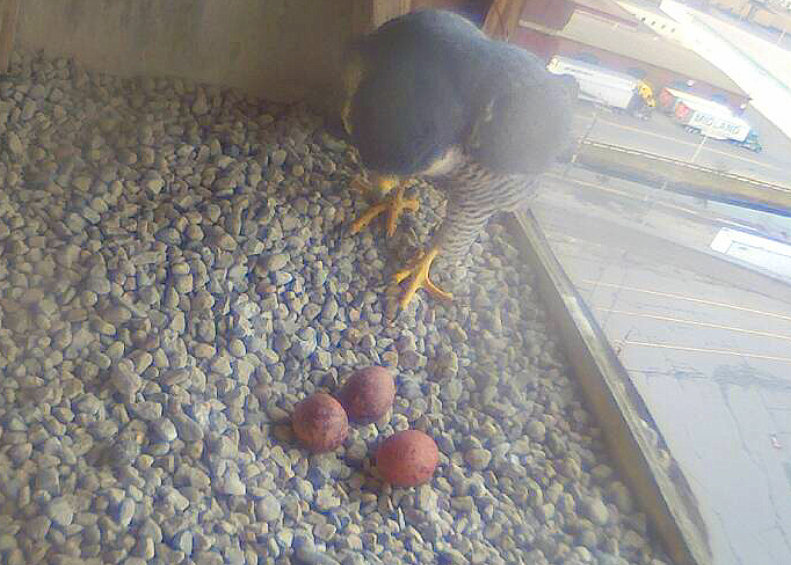
Had a look in just before 6AM and the male was incubating.  He took off in flight and returned a minutes later.  Again, he was very fidgety around the eggs, and hovered near and over eggs, but continued to behave in a tentative way.  The female returned and started wailing at him.  He departed and she settled right in over he eggs in motherly incubation mode.

2018.0417.2-001Many questions have come in about exactly what happens during incubation, in terms of embryonic development.  It is a fascinating question and related to the very mystery of life, and how young peregrines develop inside the egg. So, what happens when?

Over the next number of days, we’ll look a bit closer at how the embryo develops.  Resources will include two book on avian embryonic development and an old blog, specifically about peregrine falcons, that includes a number of entries on this topic.

The age of the embryo when the egg is laid varies. Peregrines tend to lay eggs during the night or early morning or in the evening.; if the egg is not complete until later in the day, it will probably not be laid until the next day. The rate of development of the embryo once the egg is laid also varies. If the eggs are cooled after laying, development of the embryo ceases until the temperature rises again. Development can resume even after the eggs have been cooled for several days. The temperature of eggs incubated by their mother is 106 degrees Fahrenheit The temperature of course will vary when the peregrine leaves the eggs to eat, etc. All of this affects the rate at which the embryo develops and, therefore, how long it takes for the chick to hatch.

The first 4 days are essential. A lot is going on in those 4 days. Let’s have a closer look inside the eggshell. It is a magic journey through the universe of the dawning of life itself.

First Day: The Journey Begins

Before the Egg is Laid:

* The egg is fertilized.

* The zygote divides and begins to grow.

* The cells segregate into groups of specialized function.

* The embryo nearly stops growing between laying and incubation.

During Incubation:

* The area pellucida and area opaca of the blastoderm develop.

MAJOR EVENTS

Second day:

*27 hours: The alimentary tract appears.

*28 hours: The brain crease begins to form.

*29 hours: Somites appear.

*31 hours: The brain and nervous system begin to form.

*32 hours: The head fold begins to form.

*34 hours: Blood islands appear.

*35 hours: The eyes begin to form.

*37 hours: The heart begins to form.

Third day

*52 hours: The ears begin to form.

*58 hours: The heart starts to beat

Fourth Day

*76 hours: head turns to the left

*78 hours: Amnion has enclosed the embryo

*80 hours: Allantois begins to form

*88 hours: The beak begins to form.

*92 hours: The leg begins to form.

*94 hours: The wings begin to form

Literature cited: Veldhuis, Froona, Embryo: the first four days, Sept. 6, 2008, 

http://falcoperegrinus-froona.blogspot.com/2008/09/embryo-first-4-days.html

Lawrence Peregrines: female wailing at the male!

April 17, 2018 in In the Nest Box, lawrence peregrines, Peregrine Falcons Eastern Massachusetts, Peregrine Falcons Haverhill

It’s Marathon Monday in the extended Boston area, and the day is starting with light rain with fog and mist, strong winds blowing from the NE at 18MPH with gusts close to 30MPH, and the temperature at 37F.  For the peregrines, the west facing nest box is shielded from direct winds. 

The forecast calls for rain off and on throughout the day. Some of the storms could produce gusty winds and heavy rain. Patchy fog. High near 50. Breezy, with an east wind 16 to 20 mph, with gusts as high as 32 mph. New rainfall amounts between 1 and 2 inches possible.

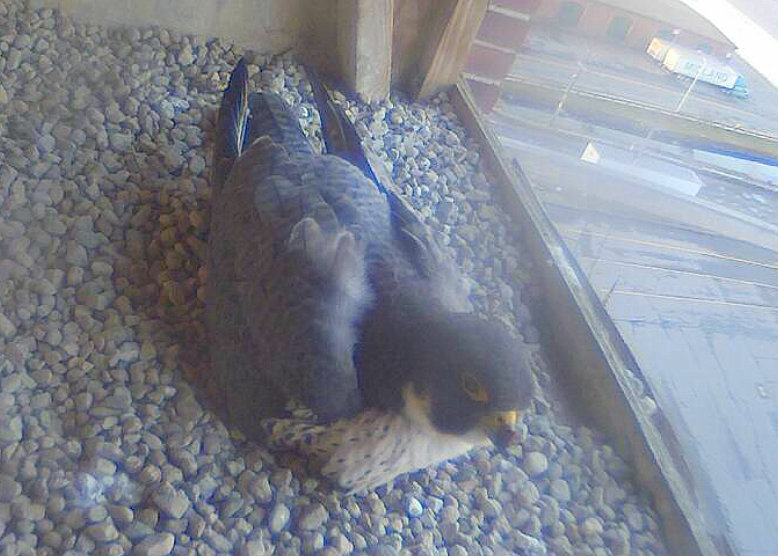
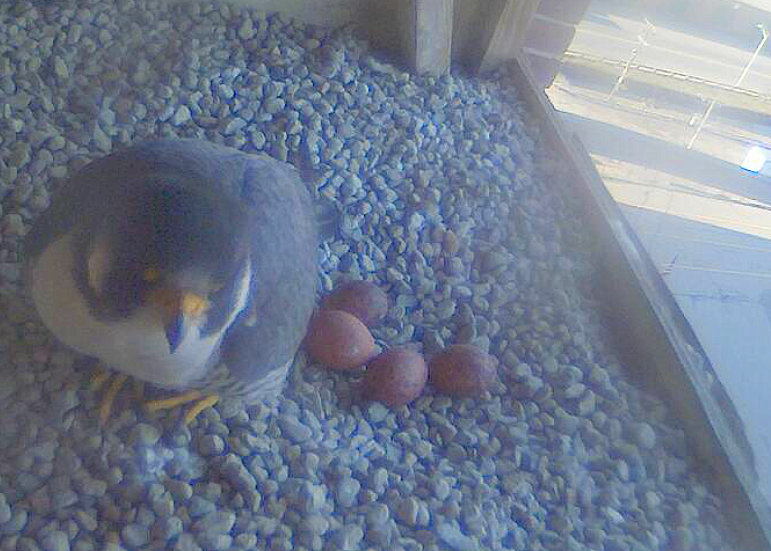
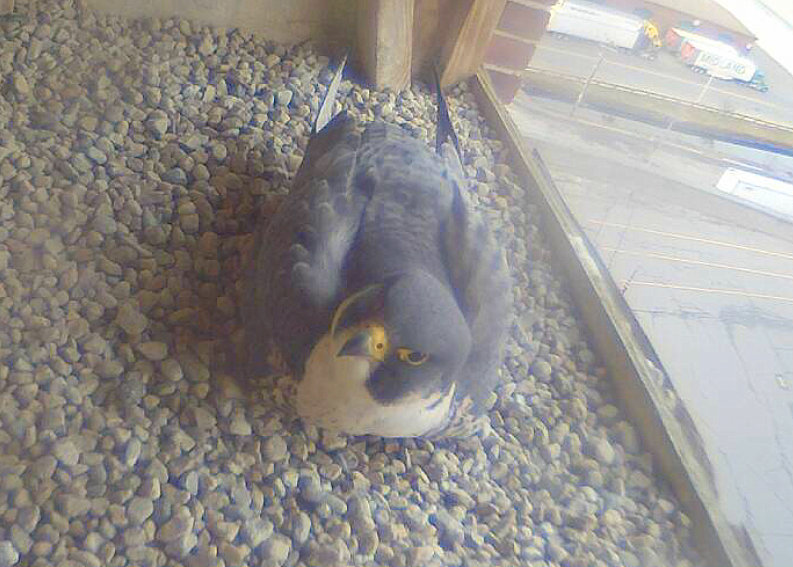
2018.0416.3-001During incubation, an observer may spend lots of time watching very little activity.  The peregrines take turns brooding the eggs. Typically, the female incubates about 2/3 of the time, often for four or more hours before the male relieves her. Males brood for shorter periods– typically 2 to 3 hours, and they brood less frequently. While one adult is brooding, the other may be out hunting. Brooding falcons still need to eat, after all. If they’re not hunting, the other falcon usually stays close to the nest.  The photo on the left shows the female sitting on eggs quietly and with great comfort.  She will adjust as she needs to but is not fidgety as the male tends to be!

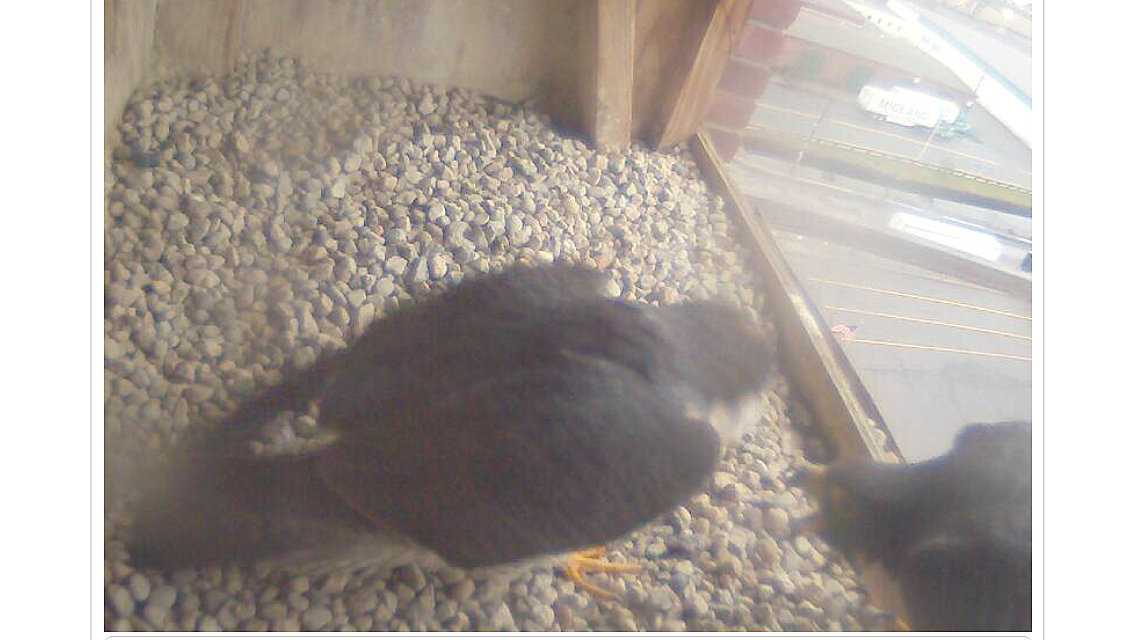
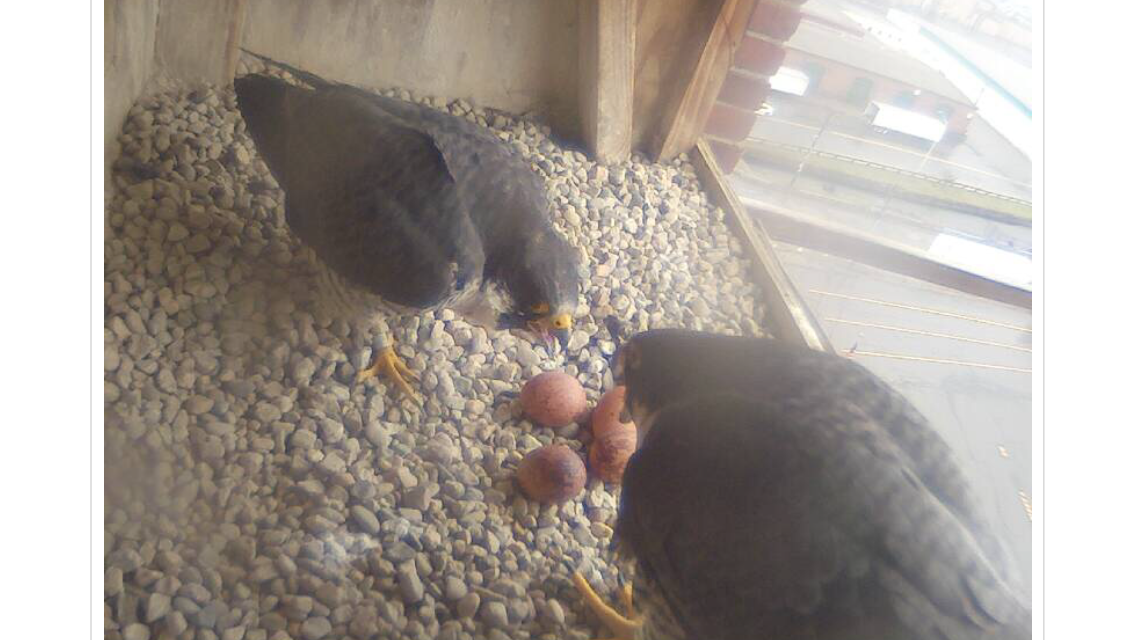
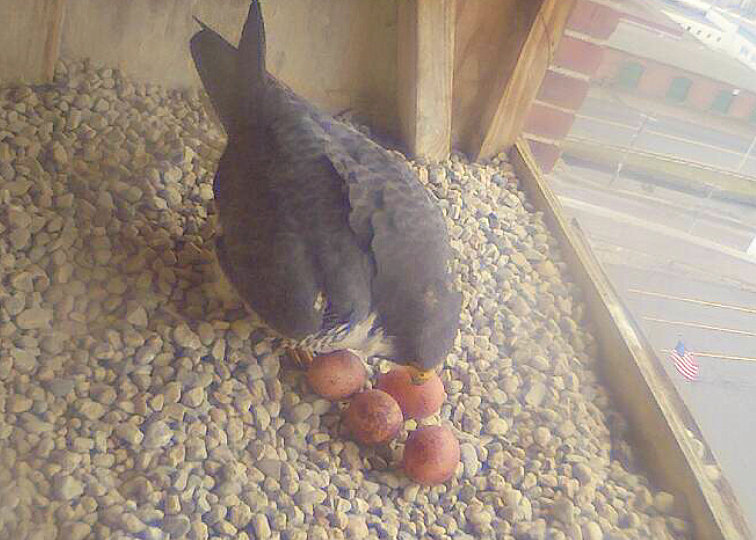
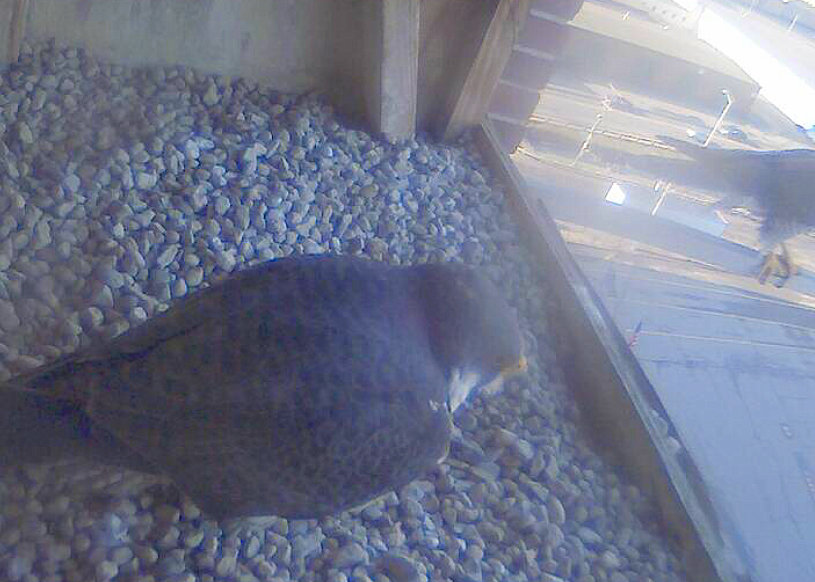
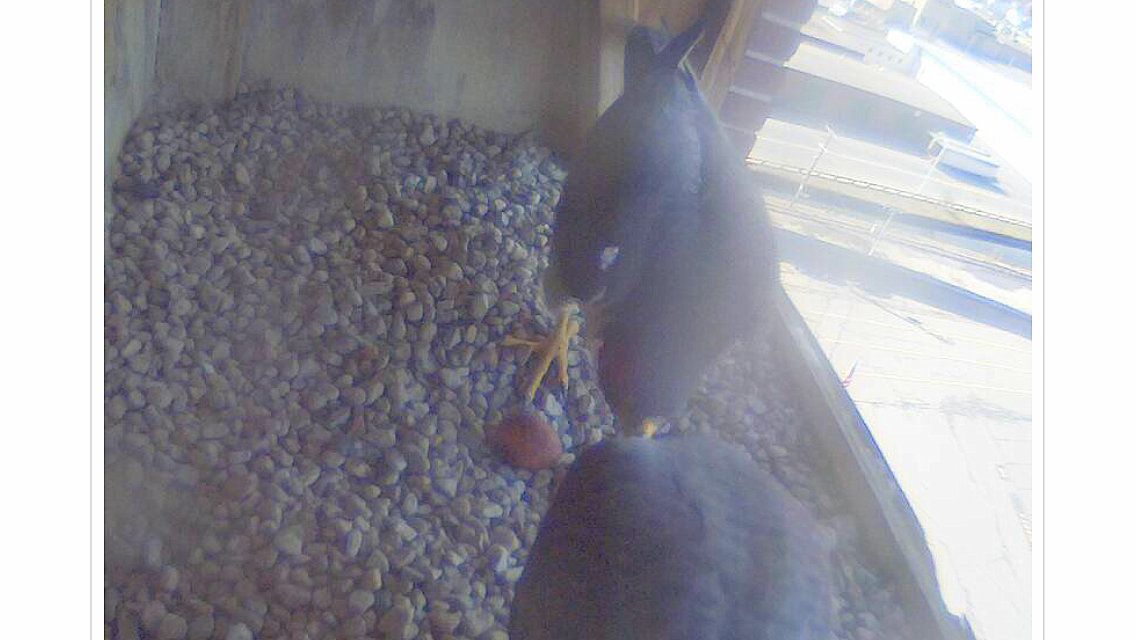
2018.0416.1Sometimes while the female is brooding the eggs, the male will bring her food that he has hunted. She’ll eat the food, sometimes inside, and other times, outside the nest box while he takes a turn incubating, but then she’ll come back and take over– provided she can get him to move off the eggs. If he doesn’t move right away, she may stand in the nest box and wail at him. Wailing has different meanings for falcons, but in general it indicates dissatisfaction with the current situation.  Here they are together, inside the nest box at around 10:35 AM today, and she is wailing on him big time.

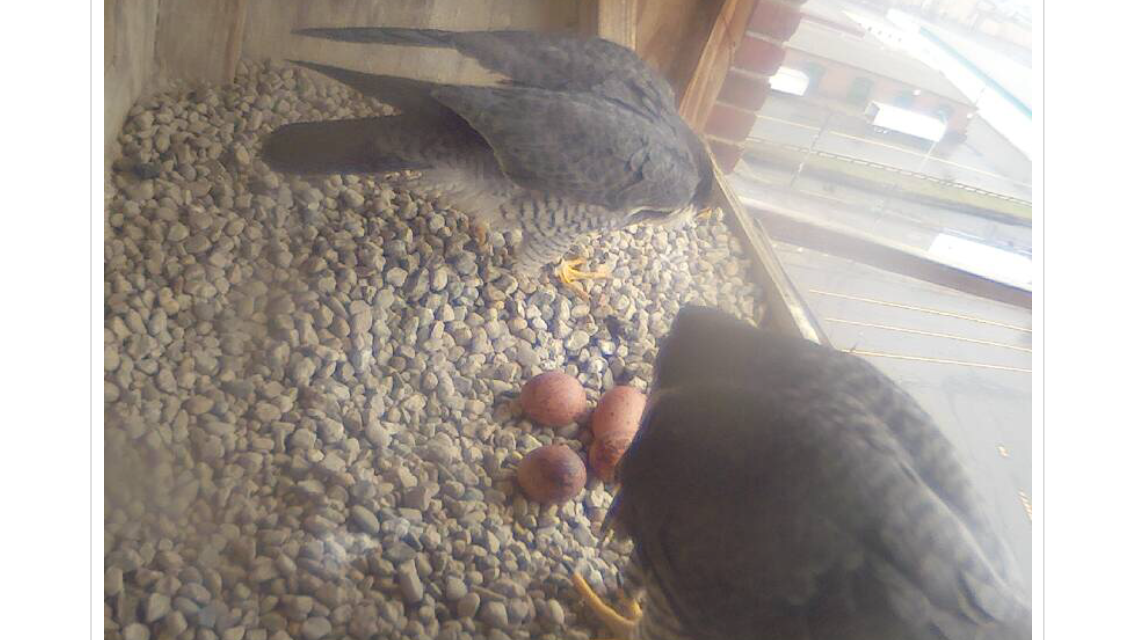
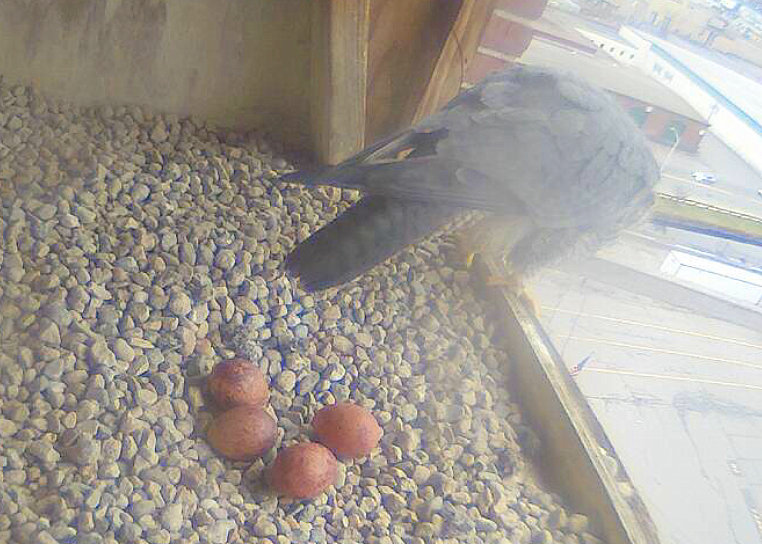
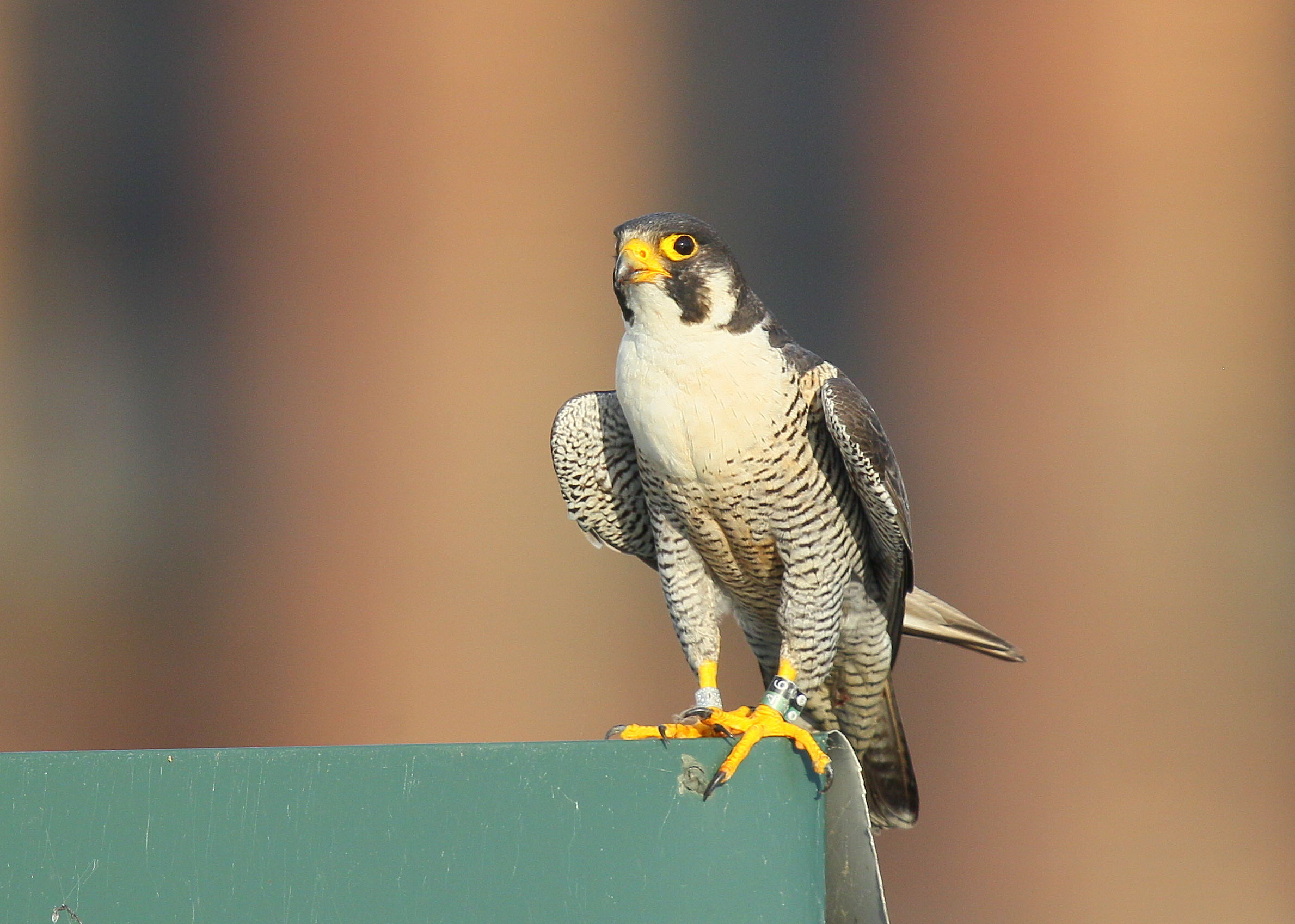
2018.0416.2So if this female wails at her guy while he’s incubating, or in the nest box it’s her way of telling him she’s not happy that he’s still standing around, or sitting on the eggs. As with most other interactions between male and female peregrines, the female usually gets her way, though sometimes it takes a while for him to get the message!  Guess who’s walking away, with his head bowed low, after getting wailed at….the male….note right leg silver leg band.

Literature cited:  Imprints Blog, The Journal of the Rfalconcam, Rochester Falcon Cam.  The Genesee Valley Audubon Society is the local chapter of the National Audubon Society in Rochester, NY. GVAS sponsors the Rochester Falconcam (Rfalconcam) as part of their education and awareness programs.

Lawrence Peregrines: what happens during incubation?

April 15, 2018 in In the Nest Box, lawrence peregrines, Peregrine Falcons Eastern Massachusetts, Peregrine Falcons Massachusetts

2018.0415.1Another overcast morning in Lawrence with winds from NE at 13MPH, gusts up to 25MPH, and the temp at 35F, but a wind chill at 26F that makes it feel much cooler 35F.  Not looking to be such a nice day.  A least the wind is from the NE and that leaves the nest box well shielded from string direct wind.

The forecast calls for a chance of rain before 7am, then rain likely, possibly mixed with freezing rain between 7am and 8am, then sleet likely after 8am. Cloudy, with a high near 32. Northeast wind 10 to 13 mph, with gusts as high as 26 mph. Chance of precipitation is 70%. Little or no sleet accumulation expected.

2018.0415.2A number of times today, the eggs were left alone for longer stretches of time than is normal.  Did not observe a changing of the guard between male and female!


2018.0415.3During the normal course of incubation, one of the adults is nearly always on the nest. Exceptions are during disturbance, for short periods on particularly warm days, or for a few minutes during food exchanges. The female does the majority of incubation. The male brings food to her several times daily, or sometimes simply relieves her and takes a turn on the eggs while the female eats, preens, and relaxes. When she returns to the nest box to relieve the male, he usually is waiting on the outer edge of the nest box. It is often a a challenge to identify the male from he female, as the male’s leg band is not always easy to see.  It will be helpful to identify field marks to distinguish the sexes.


Literature Cited:

Cade, T. J., J. H. Enderson and J. Linthicum. 1996a. Guide to Management of Peregrine Falcons at the eyrie. Boise, ID: The Peregrine Fund, Inc. (Excerpt: Linthicum, Janet. Observing Breeding Behavior)

Lawrence Peregrines: very handsome eggs!

April 14, 2018 in In the Nest Box, lawrence peregrines, Peregrine Falcons Eastern Massachusetts, Peregrine Falcons Massachusetts

Saturday morning started off with clear skies and bright sun, with a bit of haze.  During the morning the skies turned partly cloudy and then completely overcast.  The wind started out from the north at 8MPH, and then shifted around to the east, but remained around the same speed until picking up speed late in the day.  The temp hovered around 50F most of the day.

2018.0414.1The peregrines spent most of the day in incubation mode.  Some times, you have to watch for quite a while until you observe a break in the action!  It is fascinating to watch how careful they are when hovering over and then settling onto the eggs.  Frequently, you will be able to watch a nervous twitching and jiggling around until the incubating bird gets it just right.


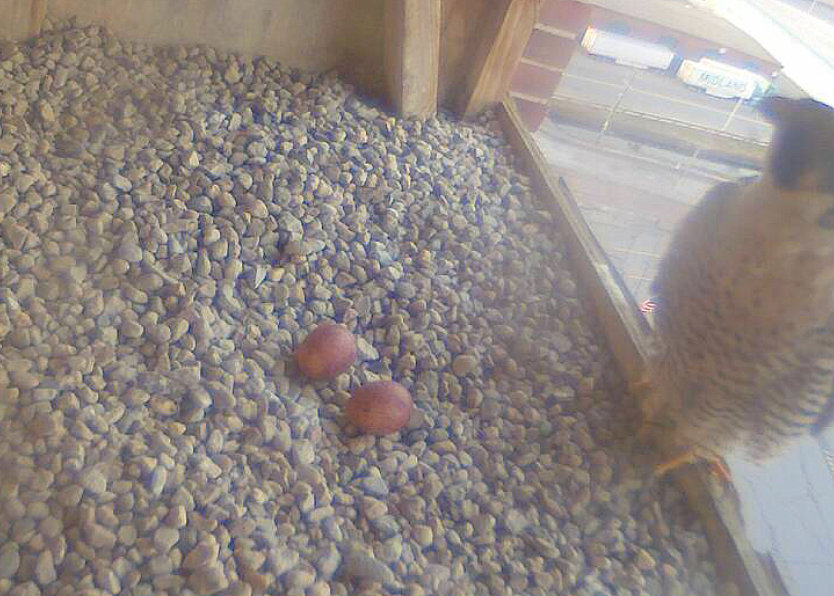
2018.0414.2According to Derek Ratcliffe, the eggs of the peregrine falcon are among the most handsome laid by any species of bird!  He notes that the prevailing color is reddish-brown with a wide variation.  The surface of the fresh egg has variable amounts of bright red-brown markings appearing as a freckled, mottled, or blotched layer which can easily be rubbed off when the shell is wet. This non-fast layer of pigment gives a peregrine egg much of its beauty and richness, and in fresh specimens is often accompanies by a kind of bloom!


Literature cited: Ratcliffe, D. 1993. The Peregrine Falcon. 2nd ed. Carlton, England: T. and A. D. Poyser.

Lawrence Peregrines: full time incubation begins!

April 13, 2018 in In the Nest Box, lawrence peregrines, Peregrine Falcons Eastern Massachusetts, Peregrine Falcons Massachusetts

Onset Of Broodiness And Incubation In Relation To Laying

2018.0413.1Here is a look around 6:30 AM this morning, under clear skies, winds from the west at 8MPH, and temps in the low fifties. It looks like we have officially started full time incubation. In temperate latitudes, full time incubation usually begins with the penultimate, or second to last egg egg.  When temperatures are at or near freezing, active incubation may start a bit earlier. We have now seen either the female or the male incubating the eggs with almost no break in between shifts, since the fourth egg was laid.  The male seems to be taking a very active role in the incubation process.

2018.0413.2Incubation Patches

Both sexes have paired lateral brood patches. Less well developed in male. Belly area may function as patch also but less edematous and vascular than breast (TJC).  In this photo, the male is taking a break on outside edge of the nest box.  He waited a while until the female showed up and set down on the perch pole outside the nest box.

2018.0413.3Incubation Period

The peregrines at this location have usually incubated their eggs for 29 to 33 days. In the early days of brooding it’s important to keep the eggs as close to their ideal incubating temperature as possible. If it is too hot or too cool and the eggs won’t develop properly. Later in the incubation process, proper temperature isn’t quite as important.  After a couple of weeks the falcons will be able to leave the eggs uncovered for longer periods of time.  Sometimes leaving the eggs uncovered frequently, or for long periods can mean that the eggs hatch a few days later than normal. This is a very well protected nest box in a location where the resident peregrines will not be disturbed, so they will tend to incubate steadily until the eggs hatch.

Literature cited:

White, C. M., N. J. Clum, T. J. Cade and W. G. Hunt. 2002. Peregrine Falcon (Falco peregrinus), version 2.0. In The Birds of North America (A. F. Poole and F. B. Gill, Editors). Cornell Lab of Ornithology, Ithaca, NY, USA. https://doi.org/10.2173/bna.660

Lawrence Peregrines: Fourth egg!!

April 12, 2018 in In the Nest Box, lawrence peregrines, Peregrine Falcons Eastern Massachusetts, Peregrine Falcons Massachusetts

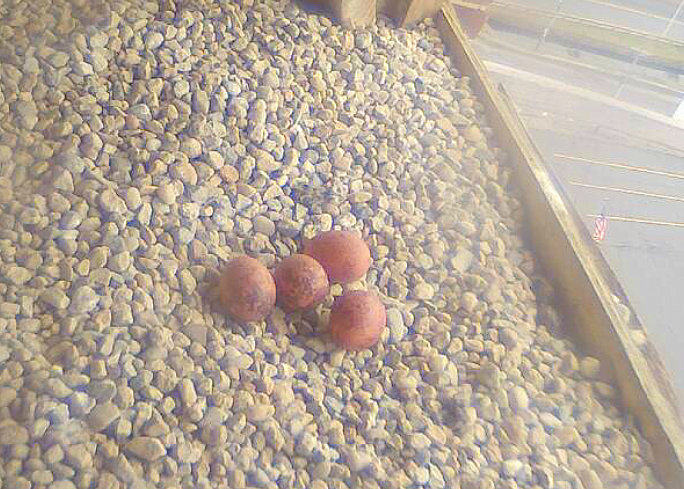
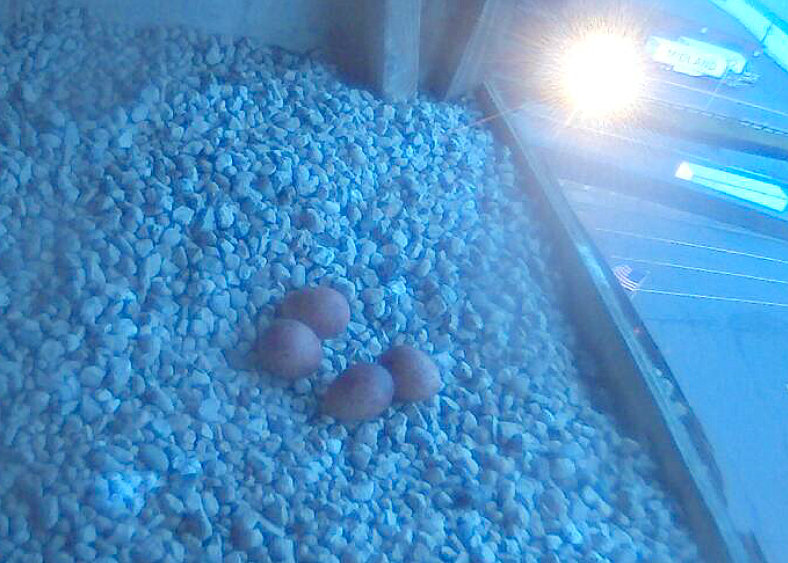
2018.0412Great news….the fourth egg was laid overnight and now the full-time incubation process begins and lasts about 30 days!  This is likely the final egg, but were not able to know for sure just yet.

Checked in a look around 6AM this morning and the female was hunkered down, in incubation mode, under partly cloudy skies, winds from the south at 6MPH, and temp at 35F.

The forecast today calls for a chance of showers, mainly after 5pm. Increasing clouds, with a high near 58. Calm wind becoming southwest 5 to 8 mph in the afternoon. Chance of precipitation is 30%. New precipitation amounts of less than a tenth of an inch possible.  Finally, warmer temps on the way!

2018.0412.1The male came in and allowed the female to take a break, and then he proceeded to incubate the eggs, now starting to share in the task of sharing the duties.  Once incubation begins, the incubation process usually takes between 29 – 33 days until the chicks hatch!  During this time the weather is expected to become warmer!  Despite the dramatic events of the last two weeks, the circle of life continues on!

Lawrence Peregrines: Three eggs!!

April 10, 2018 in In the Nest Box, lawrence peregrines, Peregrine Falcons Eastern Massachusetts, Peregrine Falcons Massachusetts

2018.0410.1-001Up early just before 6AM, for a look at the possible third egg and the answer is YES!  This morning the female is waking up to overcast skies, wind from the NE at 5MPH, and temp about 34F.

The forecast for today: Scattered showers, mainly after noon. Mostly cloudy, with a high near 47. Calm wind becoming south around 6 mph in the afternoon. Chance of precipitation is 50%. New precipitation amounts of less than a tenth of an inch possible.


The female was moving around quite a bit late yesterday afternoon, and spent time standing over the two eggs.  It looked like she was ready to drop the third egg, but the timing was not yet right.  Looks like the third egg was laid after dark.  The time interval between egg #2 and egg #3 looks to be in the range of 56 -64 hours, or just a bit more than 2 days apart……well within normal range!

2018.0410.2Around 6:25AM the female departed for another break, and then returned and perched on the outer pole for a while, before returning to the inside of the box…


2018.0410.3Once again, she hovers over the eggs, and then nestles in back in incubation mode to keep the eggs warm.  The male has not yet engaged in incubation duties, but will do so shortly!

Lawrence Peregrines: waiting for next egg…

April 9, 2018 in In the Nest Box, lawrence peregrines, Peregrine Falcons Eastern Massachusetts, Peregrine Falcons Massachusetts

2018.0409.1-001Today may be the day that the female lays her third egg!  The second egg was laid Saturday in the middle of the day, and typically the female will lay eggs about 48 hours apart.  Today the female woke up to clear skies, and winds from the west at 10MPH, and temperature around 30F.  The wind chill was around 21F and with the wind blowing from the west, she felt the chill and spent lots of time incubating the eggs and protecting them from the cold.  She did spend time perched at edge of nest box and on the outer perch pole.


2018.0409.2-001Late in the morning, the male arrived in the nest box with prey and it was a joy to watch them engage in pair bonding as a new pair, and  watch them in a classic food exchange.  The photo shows the males with back to camera and the female facing the camera.  By this time the temps had moved up a bit, but the wind chill at 27F, made the air still feel quite cold.


2018.0409.3-001By late in the afternoon, the temps had warmed up to mid-forties, with wind chill just above 40F.  The wind remained fairly steady and continued from the west at 10MPH.  The female spent time hovering over the eggs, rather than squatting low in incubation posture.  It seemed like she might be ready to lay another, but turns out, not just yet!

A Falcon Soars Above Lawrence for 16 Years, Falls To Rival!

April 6, 2018 in lawrence peregrines, Peregrine Falcons Eastern Massachusetts, Peregrine Falcons Massachusetts

IMG_9459A Falcon Soars Above Lawrence for 16 Years, Then Falls To A Rival

‘The end of a long and impressive legacy’                          

By Keith Eddings at The Eagle Tribune

LAWRENCE — He was first named “Crash,” for his clumsy landings as a weeks-old peregrine falcon fledgling with three siblings from their nest atop what is now the Brady Sullivan Tower in Manchester, New Hampshire, in 2001.

The four were the first of their species known to have fledged from a downtown urban setting in that state, making the event notable enough that it was covered by a local newspaper.

Crash – he was soon renamed Black6/Green4 for the colors and numbers that identified him on his leg band – was the weakest and not expected to survive. But he showed up in Lawrence a year later, met a female and made a home in an abandoned nest built by red-tailed hawks on an empty tray that had held an air conditioner on the sixth floor of the New Balance building on South Union Street. The pair eventually moved up to the clock tower over the building, formerly the Ayer Mill, where they became favorites among local birdwatchers and state wildlife officials, in part for their prolific breeding.

Black6/Green4 and the female fledged 32 chicks over a dozen years in downtown Lawrence, taking a giant step for wildlife in a dense urban environment by contributing significantly to a species that was on the federal endangered species list for 30 years. Peregrines were removed from the list just two years before Black6/Green4 was born, after a recovery that began when the federal government banned DDT, the pesticide that softened the shells of the eggs laid by falcons, hawks and eagles, causing them to crack.

The female died in 2015, at 14 years old. Another female soon took her place in the clock tower nest. The new pair had another 10 chicks over three years. Another of their annual clutches had been anticipated this spring, which would have given peregrines another foothold toward recovery.

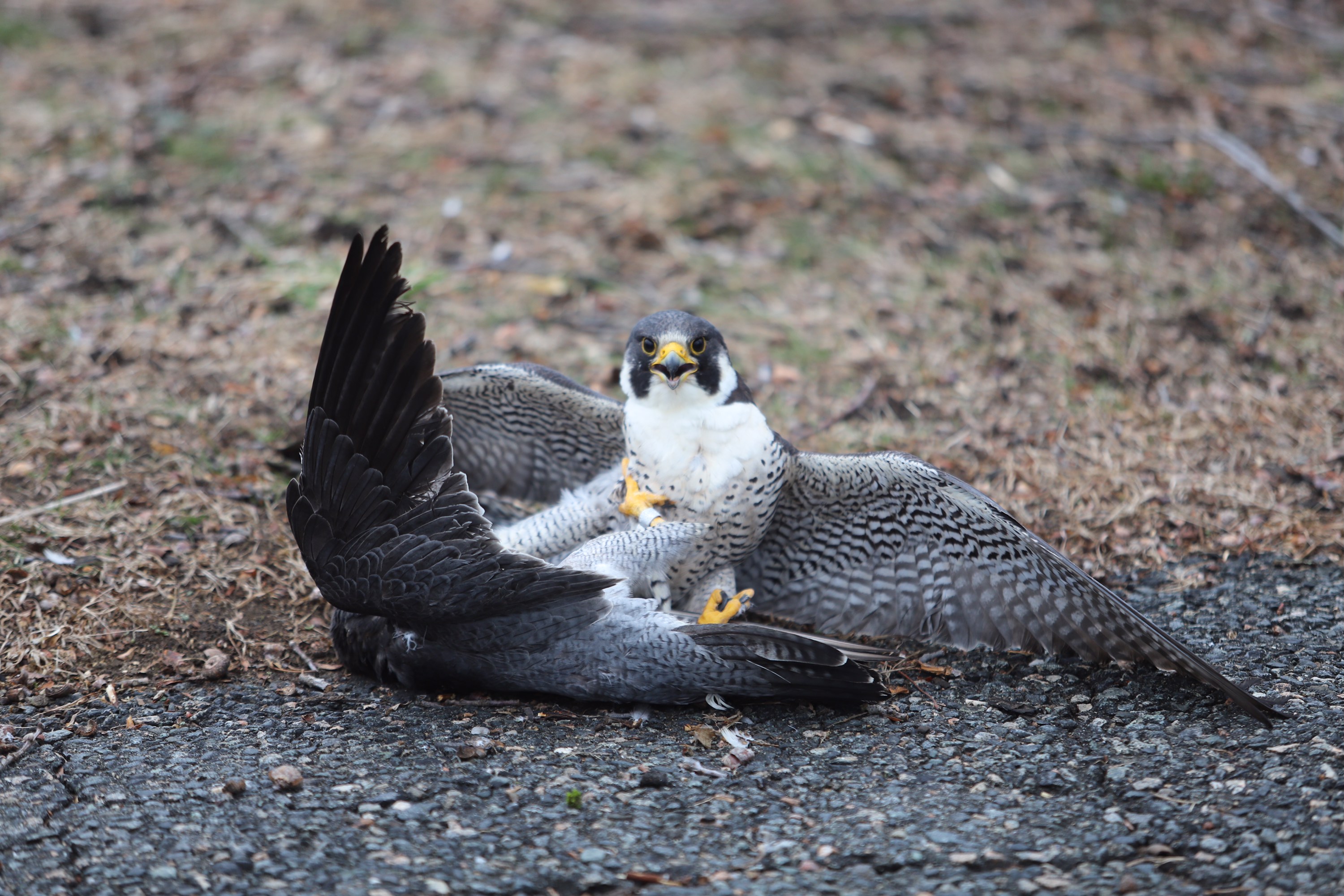
That hope ended on March 30, when Black6/Green4 left his nest to hunt for the pigeons and songbirds that are among peregrines’ favorite meals. His hunt took him to a yard on Waverly Road in North Andover, where he was confronted by a much younger peregrine that may have been stalking him for days and even visited his nest in the clock tower, state wildlife officials suspect.

Feathers flew.

“It was the unrecognizable screeches that brought us outside,” said Elizabeth Carlson, who witnessed the attack on her lawn with her son, Robert, a professional photographer who took pictures of it. “The birds were the same size, but the younger clearly the advantage…. Growing up around all sorts (of animals) I have never seen such aggression.”

The younger bird flew off when the Carlsons and two others approached but quickly resumed the attack, swooping down from surrounding trees and between the four people, who were standing just feet apart. Carlson said the swoops were “a little unnerving” and said the determined look on the younger peregrine’s face suggested he was asking, “You want to be next?”

The attack lasted 20 minutes. The younger peregrine flew off, leaving Black6/Green4 mortally wounded. He remained on the lawn for 20 minutes more and was able to fly off when the Carlsons attempted to place him in a box so they could deliver him to a wildlife rescue clinic.

Two days later, another homeowner found him lying in his yard in Amesbury, about 15 miles from where he was attacked. The homeowner was able to place him in a parakeet cage and posted his picture on Facebook. A New Hampshire falconer saw the picture and contacted Massachusetts falconer Wendy Pavlicek, who picked him up and delivered him Monday morning to the Tufts Wildlife Clinic in North Grafton, operated by Tufts University’s Cummings School of Veterinary Medicine.

News of the attack and the attempt to rescue Black6/Green4 spread quickly among the scores of birders in the region who have followed his life in Lawrence, including Tom French, the assistant director of the state Division of Fisheries and Wildlife responsible for the division’s endangered species program. To protect Tufts from being overwhelmed with phone calls and emails seeking to learn the peregrine’s fate, French sent out an email declaring himself the point person between the birders and the rehab center.

“He is in very poor shape,” French said in an email to the birders Monday. “He is severely emaciated and very depressed, so he is now being kept in an oxygen cage. He has bruises and talon punctures, but apparently no broken bones.”

A few hours later, French sent another email.

“I just learned from the Tufts Wildlife Clinic that the 17-year-old male Peregrine Falcon, 6*/4* from Lawrence just died,” he wrote. “This is not a surprise, but it is the end of a long and impressive legacy.”

By then, the bird that attacked and killed Black6/Green4 had moved into his nest and copulated with his mate.

On Thursday, she laid her first egg. She laid another Friday night. One or two more are expected to follow over the next few days.

It was a Shakespearean end to Black6/Green4’s life, straight from the pages of “Hamlet.” But his fate is common among peregrines, French said Friday.

“That’s the way it works,” he said. “The old-fashioned concept (of how peregrines meet and mate) is that a young male and a young female settle into a place to reproduce. In reality these days, a lot of the best places already are taken. So a hostile takeover is more common. When they get to breeding age and move around looking for a place, they find one that has an established pair and kill the member of the pair that’s the same sex. If they succeed, they inherit the mate, the nest and all the territory that goes with it.”

Females will attack females with the same purpose that males attack males, French said.

At 17, Black6/Green4 was the second oldest peregrine ever recorded in Massachusetts, French said. The oldest disappeared at 19 and was never found. Their average lifespan is 10 years.

The Lawrence falcon’s long life and the 42 chicks he produced with the two females is a landmark event in the peregrine’s more than half-century of recovery nationwide, including when they went extinct first in Massachusetts in 1955 and then the entire eastern United States. The first returned to Massachusetts in 1987. Today, there are 48 known pairs in the state.

“Peregrines are one of the icons, the poster children,” of the recovery all raptors have made since the pesticide DDT was banned in 1972, French said. “There are a lot of superlatives to describe them. They’re the fastest animal in the world. The fastest measured at 242 mph in a dive. They’re (unique) in their design and engineering and they’ve been marveled at since the kings and princes of falconry in the Middle Ages. They have a lot of history to go with them.”

Craig Gibson, the Roman Catholic chaplain at Lawrence General Hospital, had been observing Black6/Green4 in the sky above Lawrence since in November 2011. He said the bird’s life in the city is replicated daily on the streets below.

“It’s a fascinating story, right in our backyard,” Gibson said. “Here you have a 17-year-old male who was the runt of the litter. It didn’t look like (when he fledged) up in Manchester that he would make it. So he’s an incredible survival story in a city where there are many who against all odds find their way to success.”

Black6/Green4 survival story includes this: He outlived his three siblings and most of his fledglings, whose fate is known because they were tagged, according to records French described in his emails to the other birders last week.

Among his fledglings, a female was killed when she flew into the Travelers Tower in Hartford while chasing a pigeon in 2003. A male with severe bumblefoot – a bacterial infection of the feet – was euthanized after he showed up in the backyard of a pigeon racer in 2004. Another female was hit by a car on Nantucket in 2009. A male living above Fox Hall at UMass Lowell lost an eye from a shotgun pellet in 2016 and was euthanized a few months later after he was found emaciated at Governor’s Academy in Newbury. Another male was euthanized in 2016 after he was struck by a plane at Logan International Airport.

Against these odds, Black6/Green4’s former mate and the young male who is taking his place in the clock tower above New Balance are expected to hatch their chicks late in May.

To see a live webcam of Black6/Green4’s nest, where his former mate is incubating eggs fathered by her new mate, visit http://lawrenceperegrines.com/, then click on “New Balance Falcon Cam”

 

Lawrence Peregrines: 6*/4* an impressive legacy!

April 4, 2018 in lawrence peregrines

CF2C1906-002Here is a recap of the impressive legacy from Tom French:

As a chick in 2001, the male Peregrine Falcon 6*/4* was one of four in the first urban Peregrine Falcon nest in New Hampshire (see attached news article).  He was probably the banded juvenile plumaged male paired to an unbanded female that first occupied Lawrence, MA in 2002.  They did not nest that year, but did the following year, and have been closely monitored ever since.  Here is a summary: 

His mates

CF2C6294-0012003-2015 – V/5 (987-98049 black over green) banded as an adult at the Lawrence nest site when captured by hand.

2015–present – An unbanded bird

Nest sites used by the Lawrence Peregrines – 3

2003-2004 – Ideal Box Company, Lawrence (current New Balance Shoe building) – S. of river – The pair nested in an abandoned Red-tailed Hawk nest built on a 6th floor window tray that once held a window-mounted air conditioning unit.  That first year the hawk nest was removed and the chicks were placed in a nest box put on the air conditioner tray.

 2005-2009 – Newark Atlantic paperboard warehouse, Lawrence – N. of river – The 2005-2006 nest site was in the 12 inch wide and 6 foot long space between the glass of a 4th floor window and a sheet of plywood covering the window on the inside of the building.  The birds entered through a broken window pane and nested on old pigeon nest material and accumulated droppings.  The window faced west on a 7 story old mill building.  The 2007-2009 locatio0n was a similar site in another window on the same side of the building.  A nest box was placed in the clock tower of the New Balance Shoe building in March 2008.  In 2009, the chicks were moved from the window nest to a crudely constructed box on the roof of the same building.

2010 – New Balance Shoe Company clock tower (same building as Ideal Box Co.), 5 South Union Street

2011 – The pair moved back to the 2007-2009 window nest on the Newark Atlantic Paperboard Warehouse.

2012-present – The pair moved back to the New Balance Shoe Company clock tower.

Production

6*/4* nested for 15 seasons.  The 2005 nest site was not discovered until the following year.

He helped fledge 42 chicks (21 male, 21 female) in 14 years (3.0 chicks/year), which is very high reproductive success.

All of the clutches of eggs at this site have been 4-egg clutches.

Reports of offspring after fledging:

Hatch year/sex

2003 female       W/5, 0987-98050 – Became the resident female at the Traveler’s Tower in Hartford, CT 2007-2015.  Struck the building while chasing a pigeon.

2004 male            Y*/9, 2206-01254 – Found 9-15-05 in a cage in the back yard of a pigeon racer, still wearing bands.  Had severe bumblefoot, euthanized

2009 female       Y/55, 1807-76492 – South Beach, Chatham, MA 8-31-09; dead on a car grill Nantucket Isl., MA 1-5-10

2010 female       38/AE, 1807-76500 – Plum Isl., MA 8-16-10, remained through the fall and winter.  Killed a White-faced Ibis (see You Tube) https://www.youtube.com/watch?v=eyqijh2sMao

2010 male            14/X, 2206-81828 – Plum Isl., MA 11-7-10, 1-15-11, 10-22-11, 11-4-11, 11-11-11.  Became the resident male at Fox Hall, UMass, Lowell, MA 6-18-14 to 7-7-14 when found grounded from

fight; treated and released at Tufts, Grafton, MA 9-30-14 and resumed his place at the UMass, Lowell nest; lost an eye from a shotgun pellet 1-8-16; disappeared from nest site on 3-29-16 after a fight; found grounded and emaciated at Governor’s Academy, Newbury, MA 4-8-16; died at Tufts Wildlife Clinic 4-11-16.

2011 female       24/AE, 1947-02310 – Plum Isl., MA 9-17-11, 9-30-11.

2012 female       31/AE, 1947-02317 – Seen for several days at West Rock State Park peregrine nest, Hamden, New Haven Co., CT.

CF2C2496-0022013 female       93/AD, 1947-02334 – Fractured metacarpal near nest 20 days after fledging 6-29-13; treated and later released.

2013 male            11/BD, 2206-81887 – Nashua, NH 3-23-15.  Nested on the I-293/Rte. 101 bridge over the Merrimack River, Manchester, NH 2016-2017

2013 male            12/BD, 2206-81888 – Became the resident male at Boston University, Boston, MA 2015-present.

CF2C3209-0012016 male            85/BS, 1156-19151 – Injured by a plane at Logan Airport, Boston, and euthanized 8-31-16.

Eleven of 42 fledged chicks (26%) were reported after fledging, including 5 males & 6 females.