2026 Lawrence Peregrines: Week Two

April 23, 2026 in In the Nest Box, Near the Clock Tower

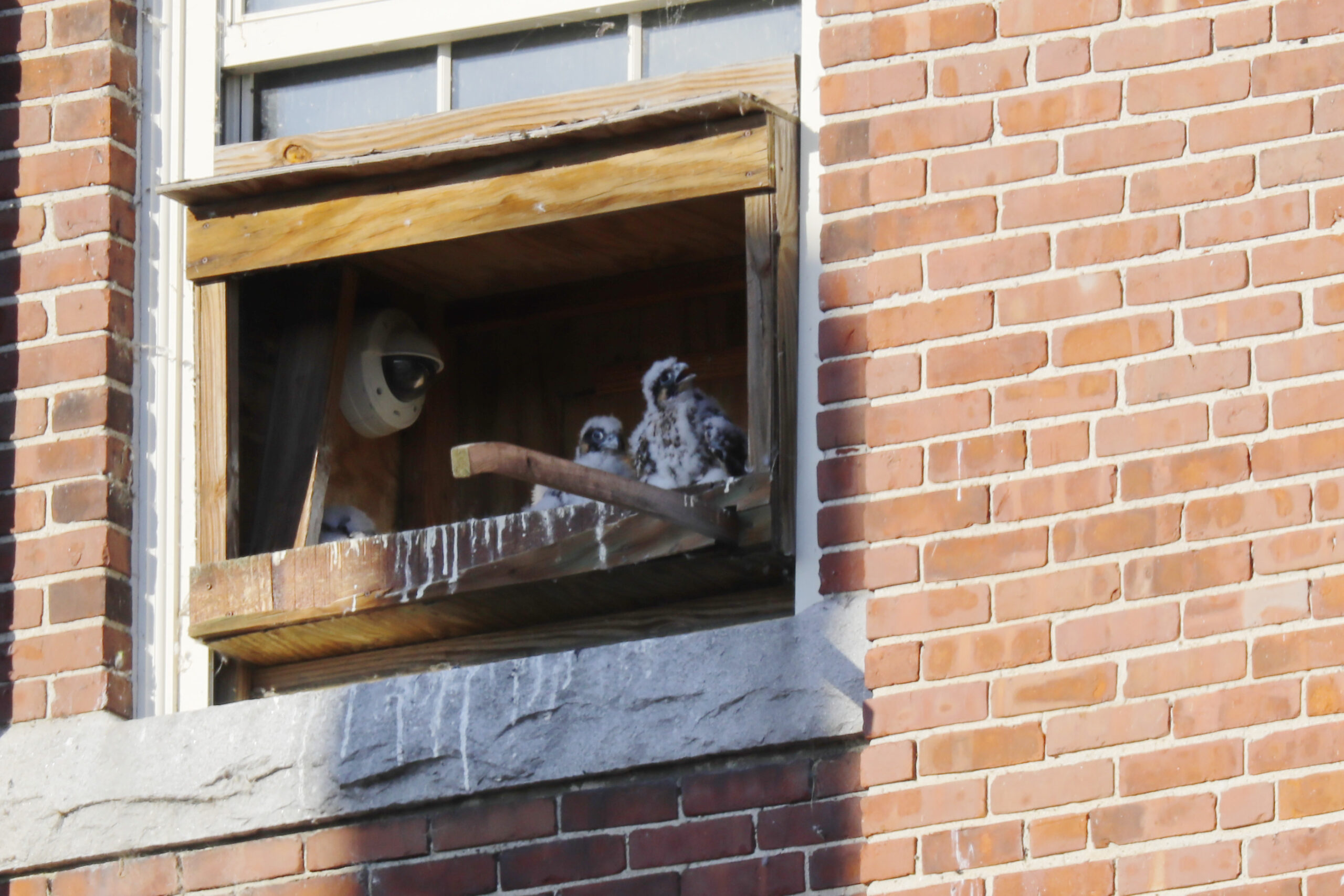
April 23, 2026: over the past week, the weather followed a typical early spring pattern, with mostly cloudy skies, periods of light rain and drizzle, and cool, damp conditions dominating much of the week. Temperatures generally ranged from the low 50s to low 60s, with occasional brief breaks of drier, milder air. Winds were light overall, and humidity remained elevated at times, even producing some patchy fog. While not especially bright or warm, the conditions were stable and seasonable, well suited for steady peregrine incubation activity.

During the second week of incubation, embryo development accelerates noticeably. The basic body plan is now established, and key structures including eyes, beak, spine, and limb buds become more defined each day. Blood vessels spread across the inner surface of the egg, supporting rapid growth and nutrient exchange from the yolk. Although nothing outwardly changes to the casual observer, the eggs are very much “alive” with activity inside. Consistent warmth remains critical, and the adults continue to make small, careful adjustmentssubtly rolling and repositioning the eggs to ensure even heat distribution and proper development.

Incubation duties continue in a steady, well-coordinated rhythm. The female still carries the primary responsibility, maintaining long, stable brooding sessions, especially overnight and during cooler or unsettled weather typical north of Boston. The male remains an active partner by delivering food regularly and taking short turns on the eggs, most often during daylight hours. These exchanges are smooth and purposeful, minimizing exposure time for the eggs. As the embryos grow and become more resilient, the pair’s routine becomes more efficient and predictable, quietly advancing toward the final stretch before hatching.

Lawrence Peregrines: Incubation Week 2

April 16, 2025 in Near the Clock Tower

April 16, 2025: Egg Development (Week 2)

– Rapid Embryonic Growth: The embryos begin developing visibly defined features such as limb buds, eyes, and a beating heart. By the end of this week, they start to resemble tiny birds.
– Increased Metabolic Activity: Nutrient absorption from the yolk intensifies, and the demand for oxygen grows as organs continue to form.
– Membrane Development: The inner shell membrane thickens, and the chorioallantoic membrane—critical for respiration and waste removal—expands across the inner shell.
– Egg Turning: Regular turning of the eggs by the adults helps prevent the embryo from sticking to the shell membrane and ensures even warmth and proper development.

Adult Peregrine Behavior Patterns (Week 2 of Incubation)

Division of Labor
– Incubation Roles:
– The female remains the primary incubator, staying on the nest the majority of the time.
– The male does brief incubating stints, often 5–20 minutes, while the female feeds or preens.

– Shifts and Communication:
– Nest exchanges are polite and purposeful, often involving soft chirps or trills between mates.
– The female may stretch or circle briefly before resettling on the eggs after a break.

Foraging and Food Delivery
– The male continues to supply most of the food:
– He may hunt multiple times a day depending on weather and prey availability (typical prey includes pigeons, starlings, flickers, and shorebirds).
– Food is sometimes partially plucked before being brought to the nest ledge or a nearby feeding perch.

Territory Defense
– Both adults maintain a strong presence near the nest site:
– The **male** often perches nearby to guard the nest and watch for threats.
– They may engage in noisy aerial displays or stoops if another raptor approaches.

Incubation Behavior
– Egg Turning: Both adults turn the eggs several times per hour using their beaks and talons—an instinctive behavior to promote healthy development.
– Temperature Regulation: The adult on the nest adjusts its posture in response to wind, rain, or direct sun, creating an ideal microclimate for the eggs.


Lawrence Peregrines: week of May 1, 2023

May 24, 2023 in Near the Clock Tower

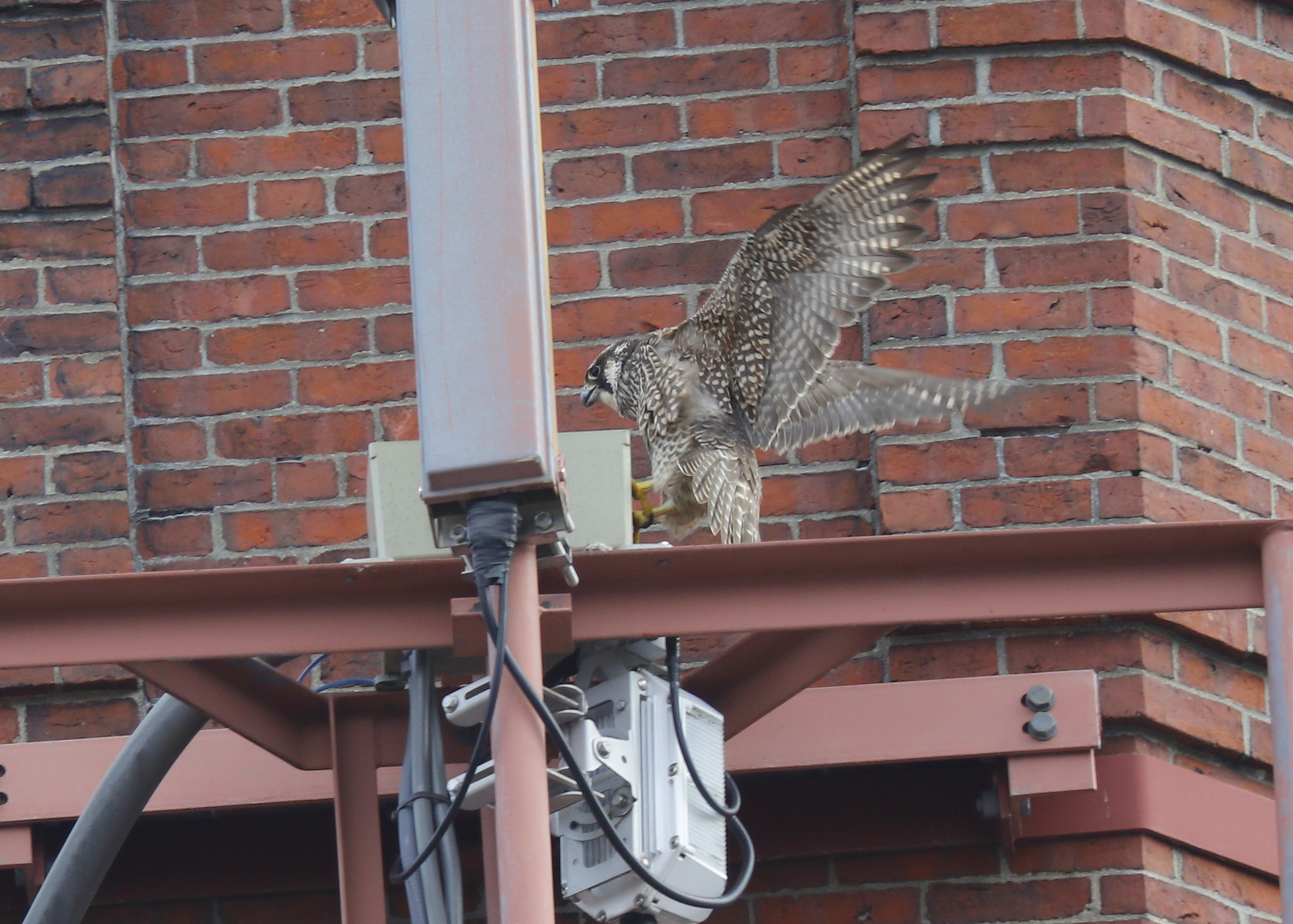
May 2, 2023 under overcast skies, wind from E at 8MPH, and temp at 51F. The sightings of the Lawrence Peregrines have been less regular compared to eight weeks.  The first stop today was around the Pacific Mills red brick smoke stack. The young female was seen moving around the gear near the top. This photo shows her jumping and landing near by with wings full outstretched.

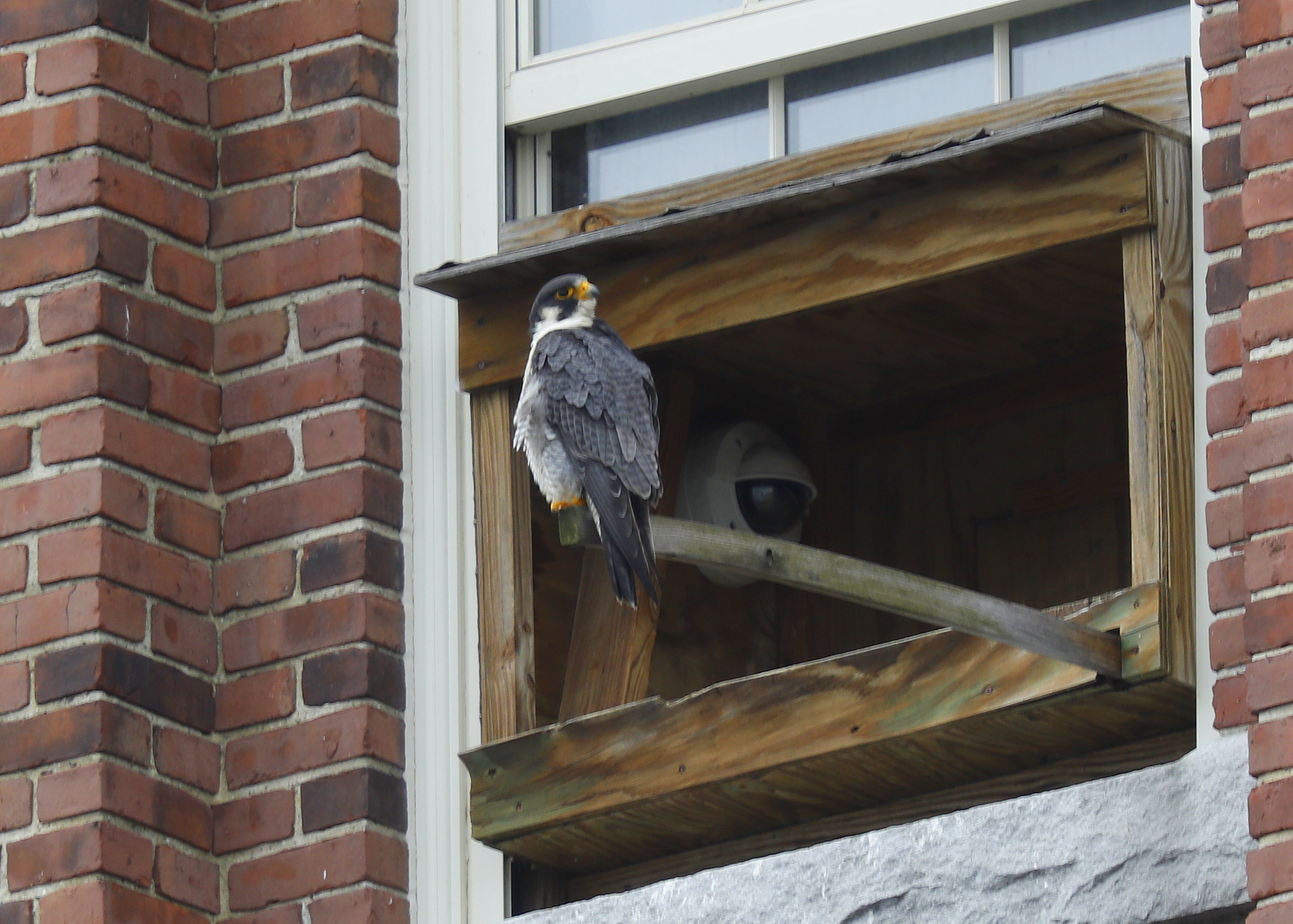
Ten minutes later, after moving over to the Clock Tower, discovered the banded male perched on the pole that extends out from the nest box. The plumage on the adult male is notably different than the young female, with dark gray coloration compared to the brownish tones on the female.

Lawrence Peregrines: week of March 20, 2023

March 26, 2023 in In the Nest Box, Near the Clock Tower

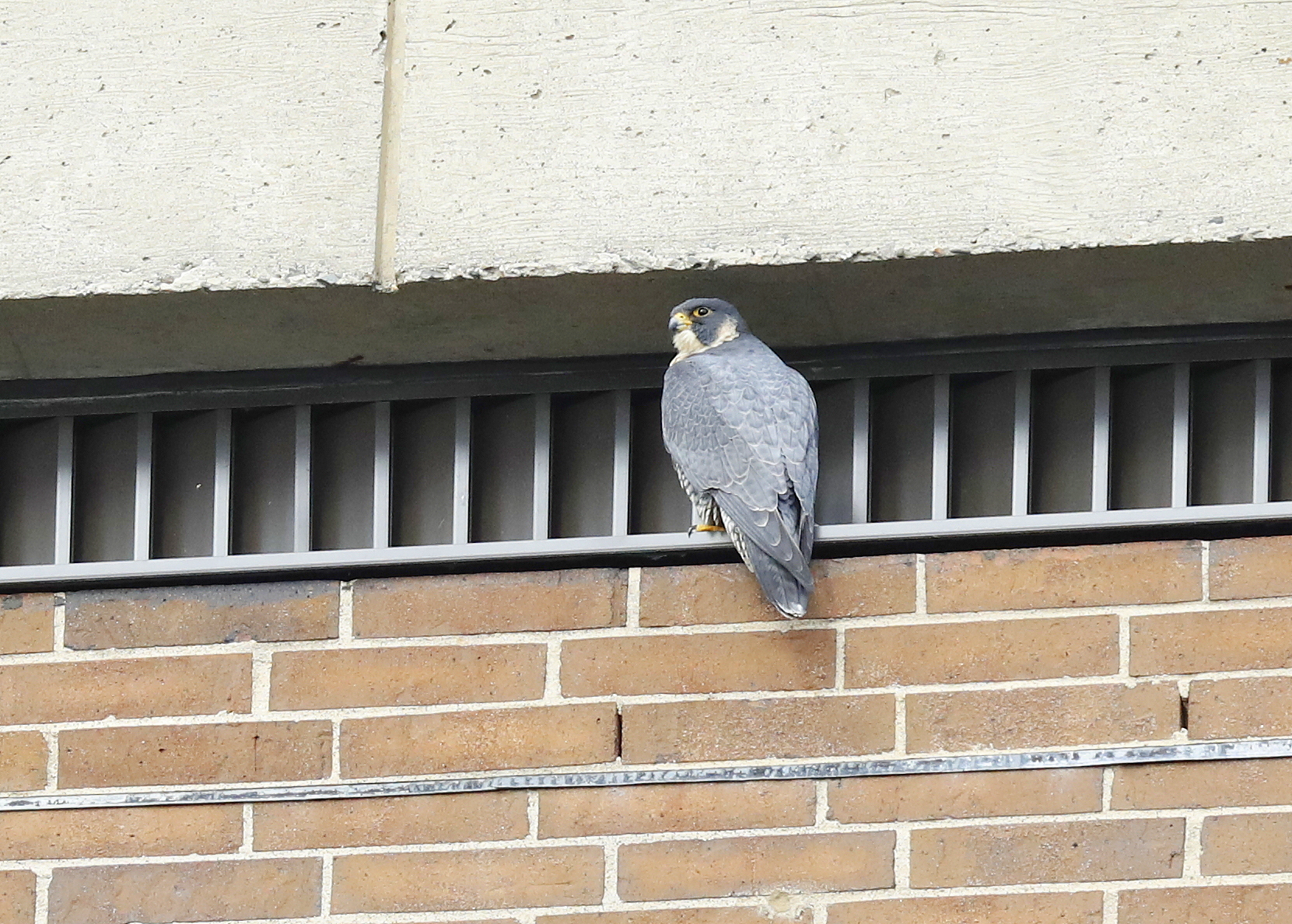
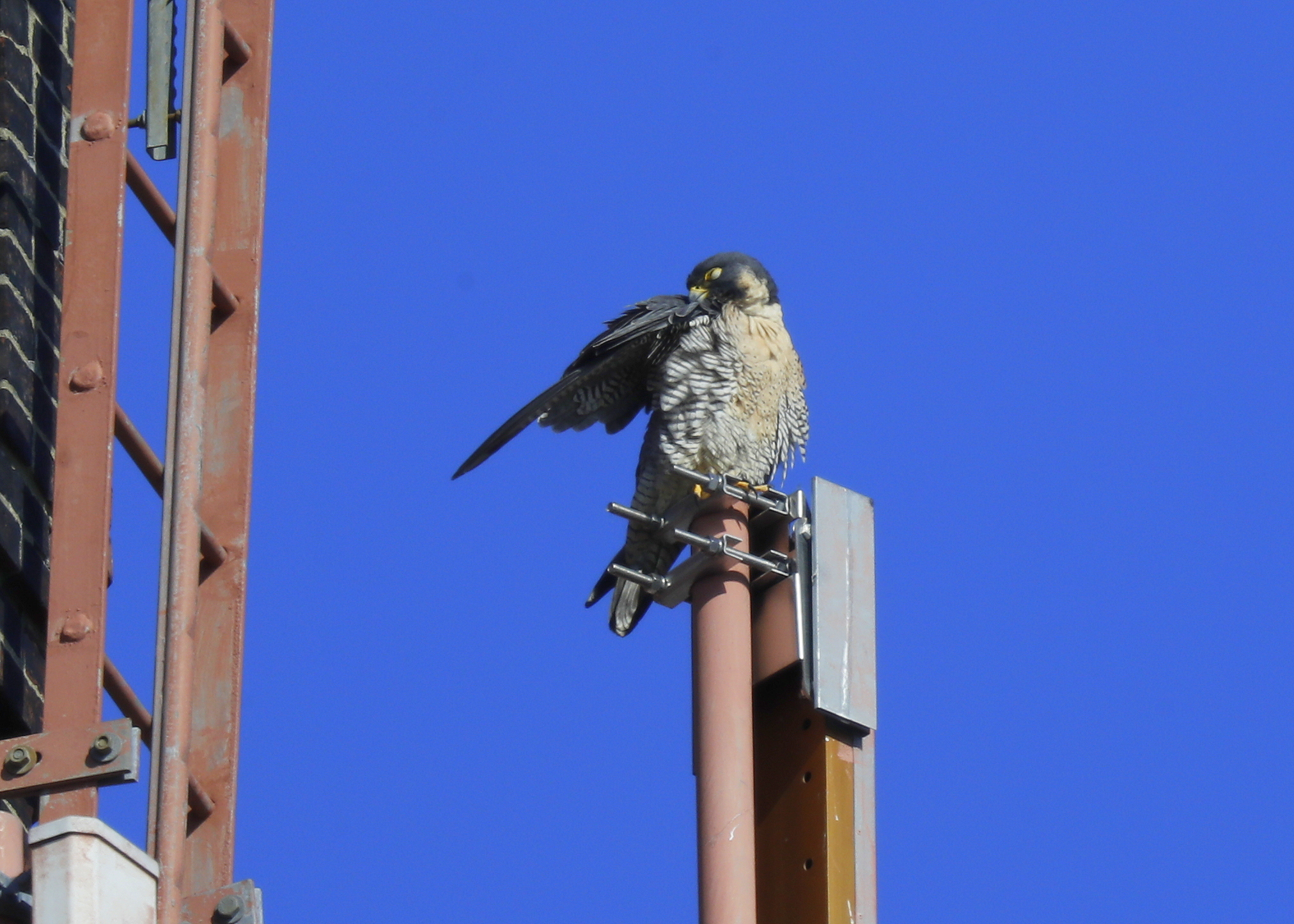
March 20, 2023 under clear skies, wind W at 13MPH, temp at 36F. After searching all around the Clock Tower, made way for the red brick Pacific Mills smokestack and located one of the Peregrines sunning and preening on the east side of the stack near the top. This was a common perch location last year when the nest ledge was under the Casey Bridge. Image just before 10AM.
Just a few minutes later while looking for the second falcon, made a possible sighting and then confirmed right away. The other falcon was perched up near the top of the Clock Tower, on the top of a north facing window frame in the shade, and just keeping an open eye. Image at 10:06AM. The falcons have not been in or near the nest box over the past week, so stay tuned!
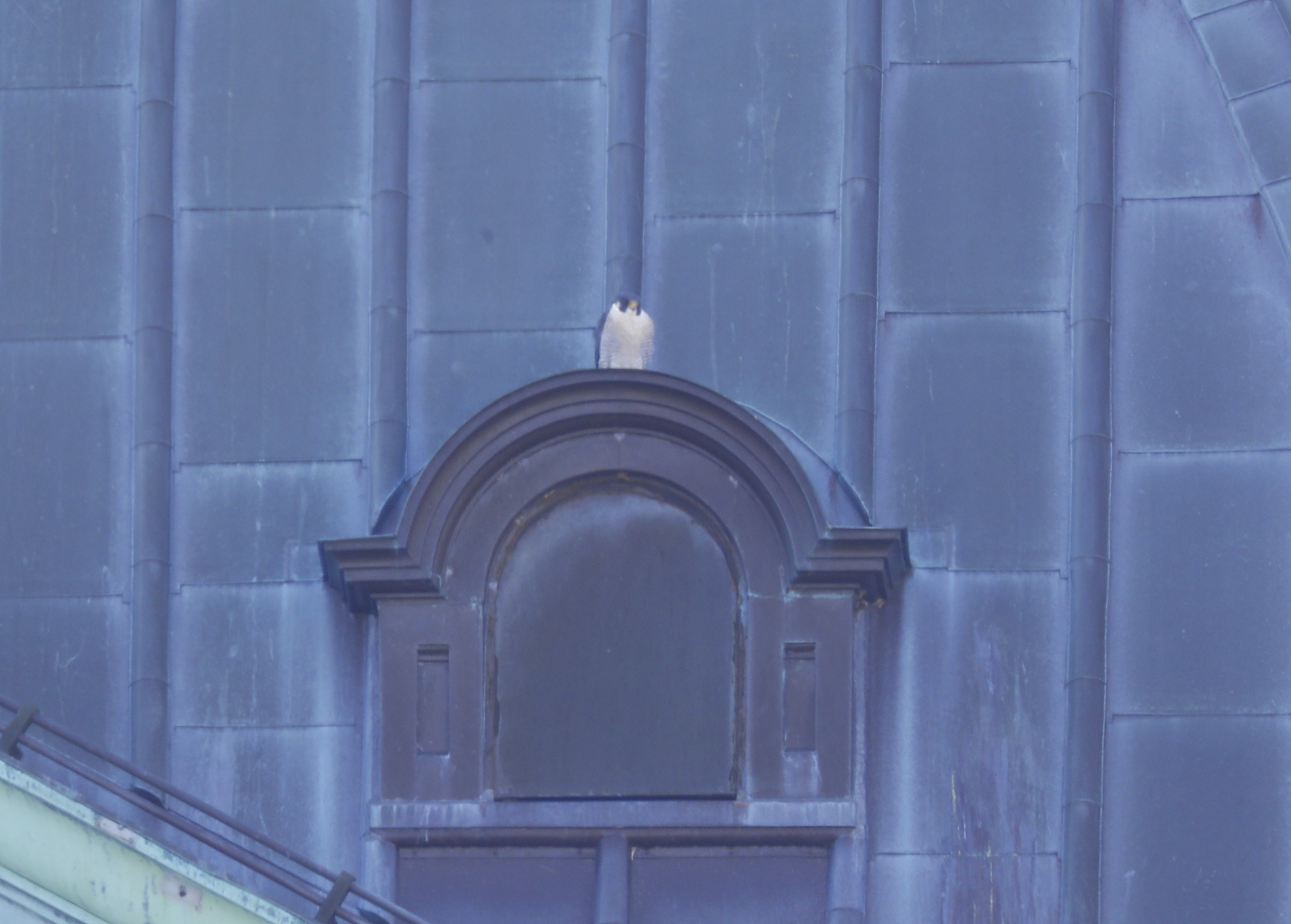
March 21, 2023 at 10AM under overcast skies, wind SW at 5MPH, temp at 44F. After initial scouting around the Clock Tower, headed west on Merrimack Street and turned north onto the Casey Bridge. About halfway across the bridge, noticed the male Peregrine perched on one of the Pacific Mills rooftop edges facing south with a gaggle of Crows nearby. The male appears to have a full crop. Peregrines like many other birds, come equipped with an anatomical feature known as a “crop.”  It is essentially a widened pouch at the bottom of a Peregrine’s esophagus, just above the stomach.  Peregrines can store food in their crops and then, slowly transfer it to their stomachs as they digest. They will often display a noticeable swelling in their chests when their crops are full.  The male has a very full crop, strong evidence that it had just finished a meal!
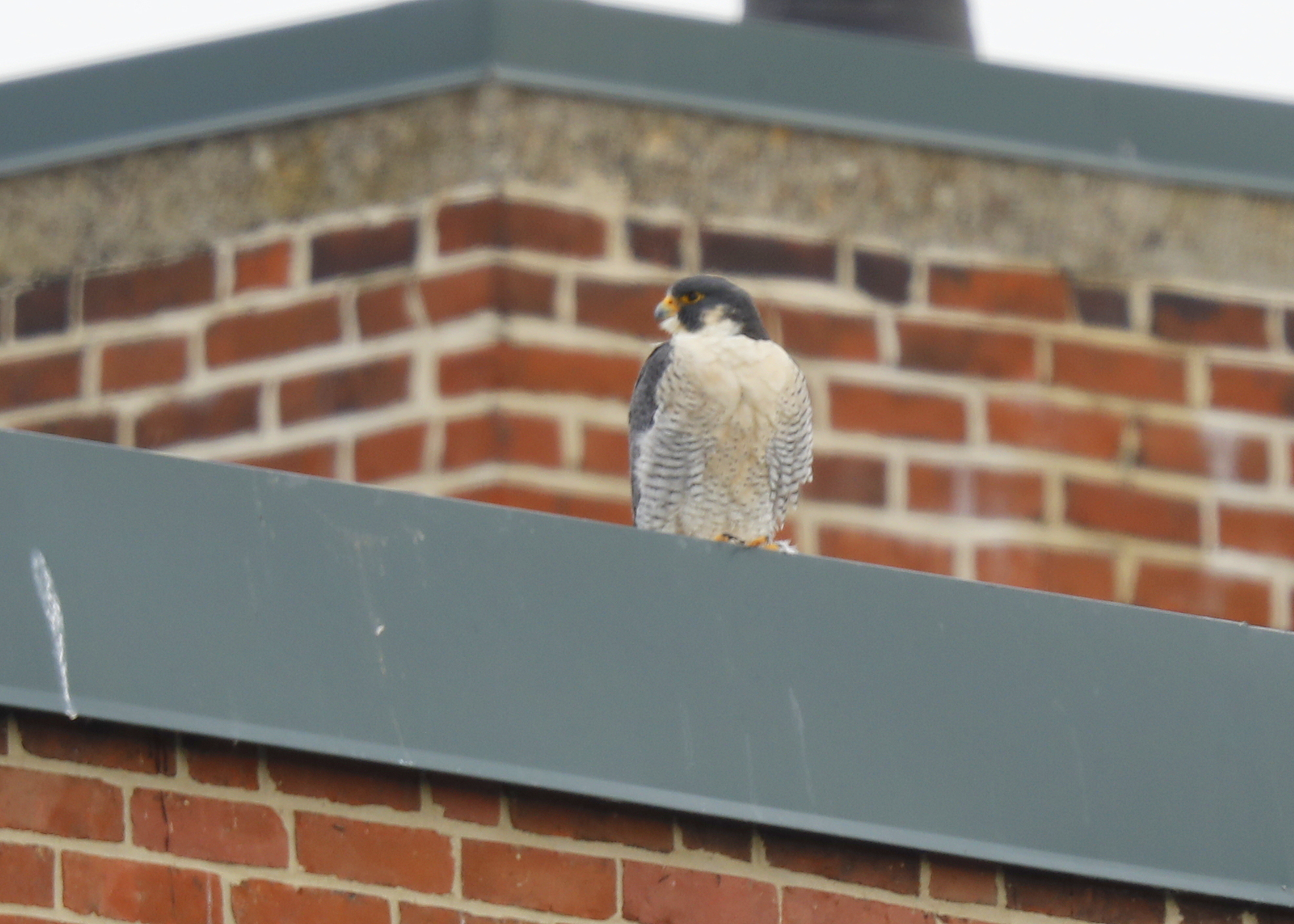
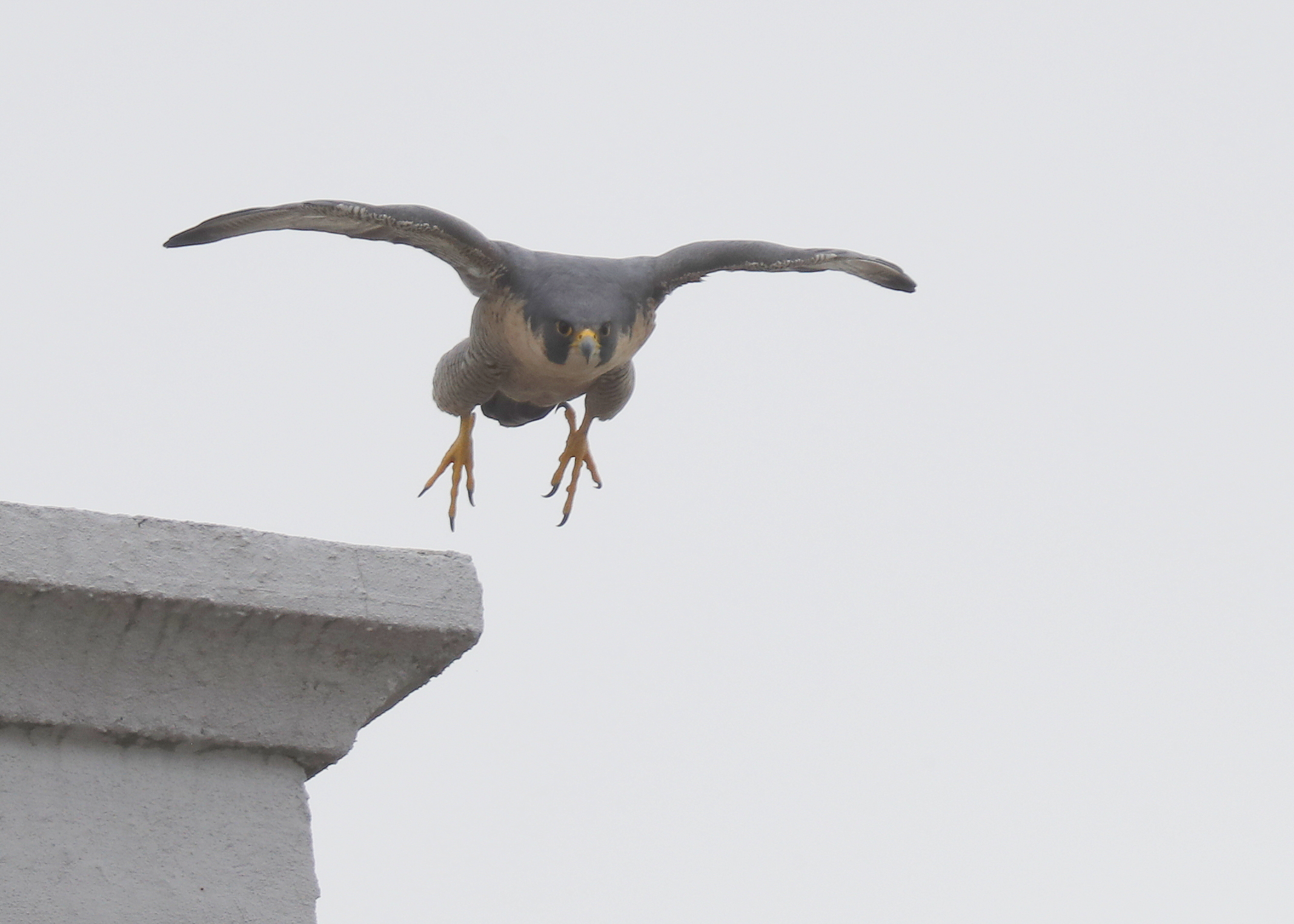
Minutes later, discovered the unbanded female lounging on the SW rooftop corner of the Mill240 building. This has been a regular perch location this spring, and provides an excellent vantage point both up and down the Merrimack River. The river is a significant flyway for all kinds of local birds and ducks. She heard the active call from the male and launched into flight and landed on the red brick Pacific Mills smokestack.
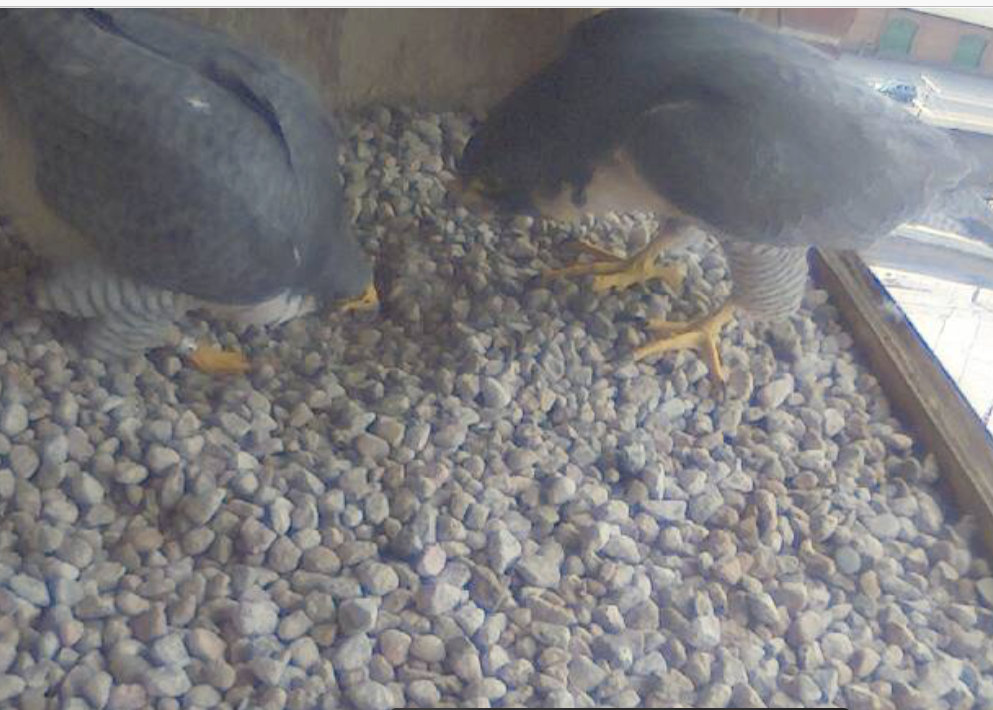
March 22, 2023, just after 10AM, under clear skies, wind NE at 6MPH, and temp at 46F. Great news this morning while checking the New Balance web cam! Not one but both male and female Peregrines inside the nest box. The male had been finishing off a meal with the female out on the perch. The female came in and then the male was seen pushing gravel around in the bowl-shaped “scrape” area in the back left corner from the camera view. One or another of the pair can often be seen to lean forward, pushing with its talons, to use its breast to form the substrate into a bowl (scrape) where the eggs will be laid.  Scraping is part of courtship. The birds continue to work on the scrape in preparation for egg laying. Eggs should appear sometime toward the end of this month, or first week in April at the latest. Stay tuned!
March 23, 2023 under overcast skies, wind W 12MPH, and temp at 59F. Made a late afternoon visit to the Clock Tower and found both Peregrines on upper ledges.

Female in flight……
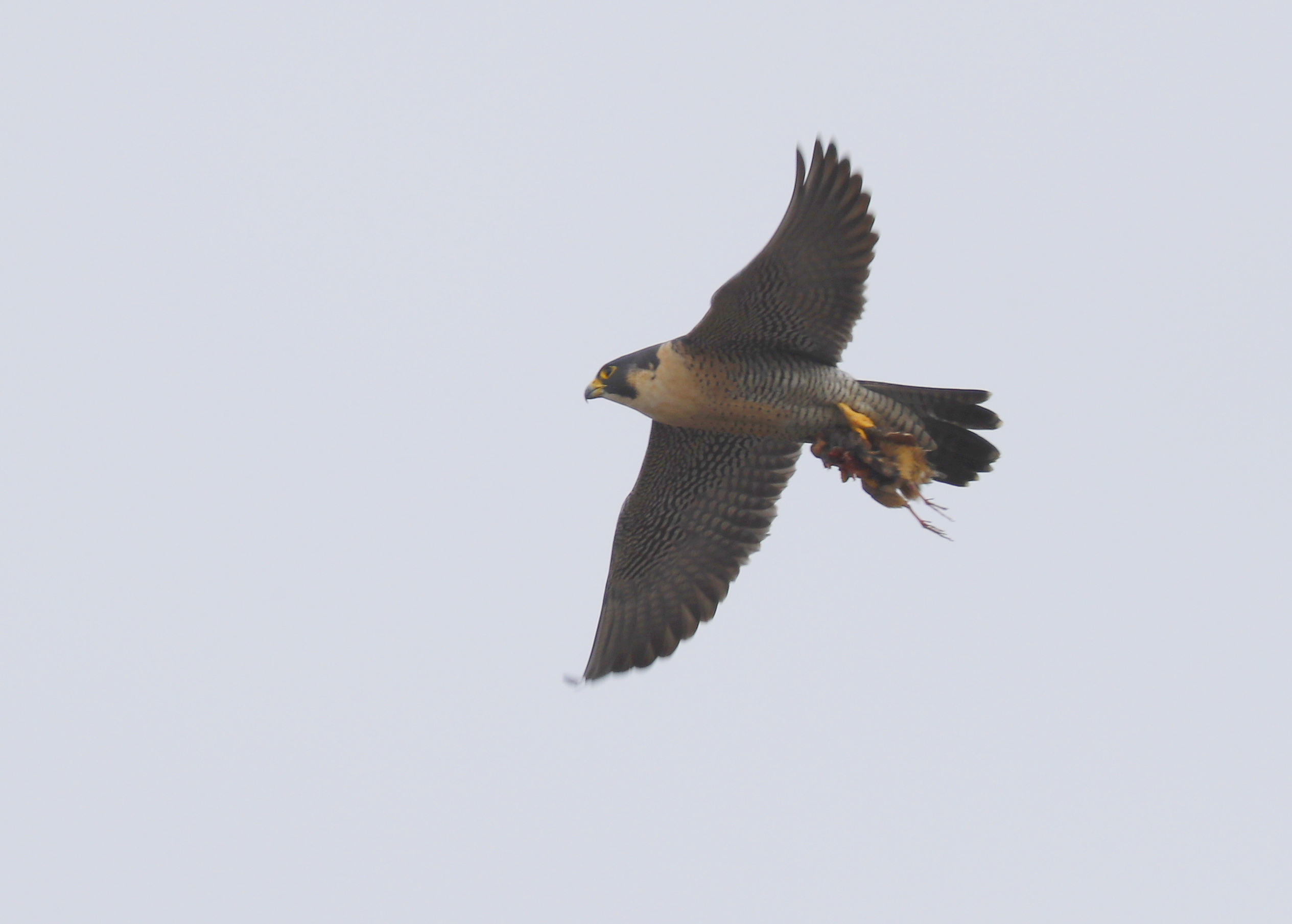
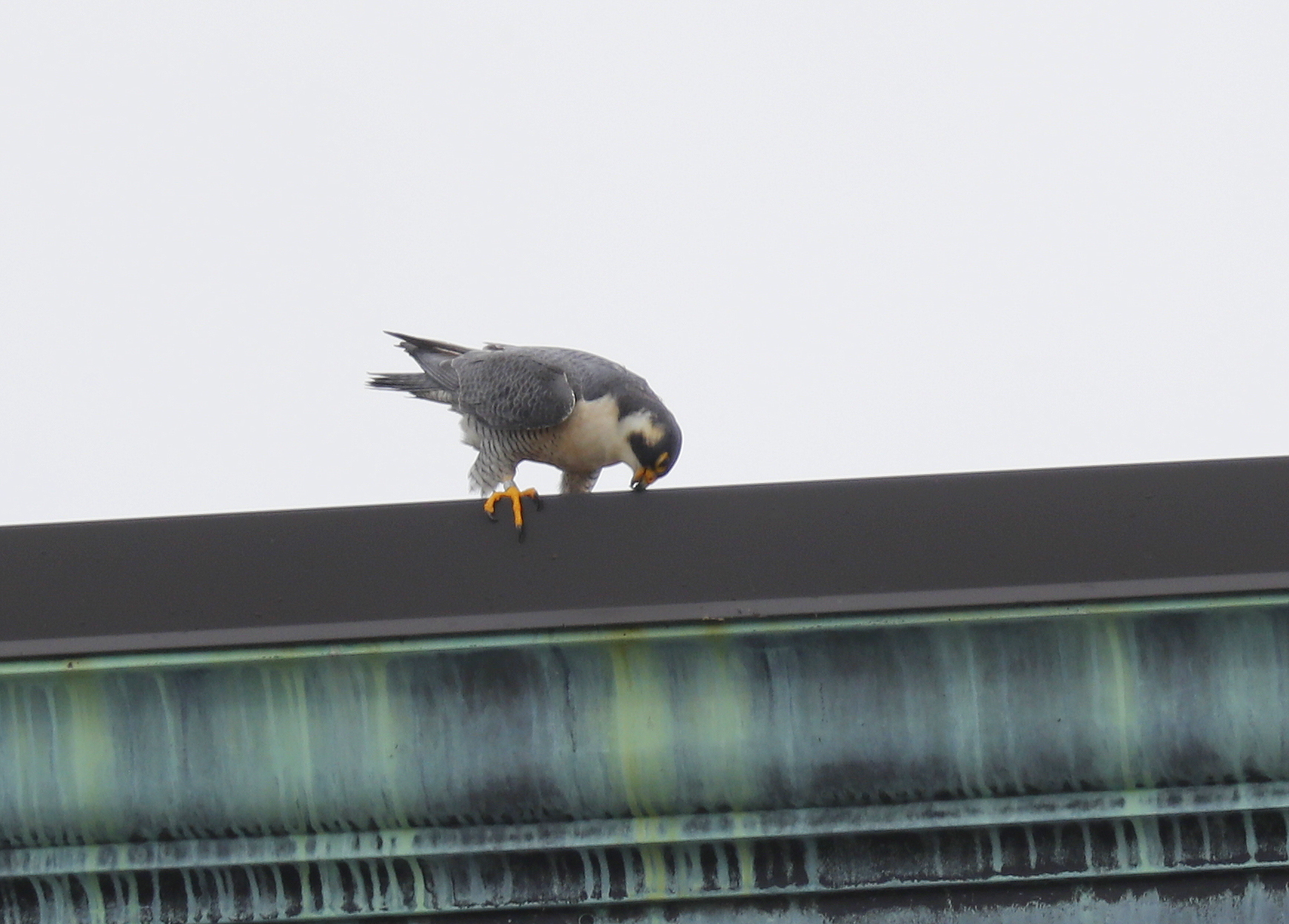
Male cleaning his bill on roof edge after food exchange
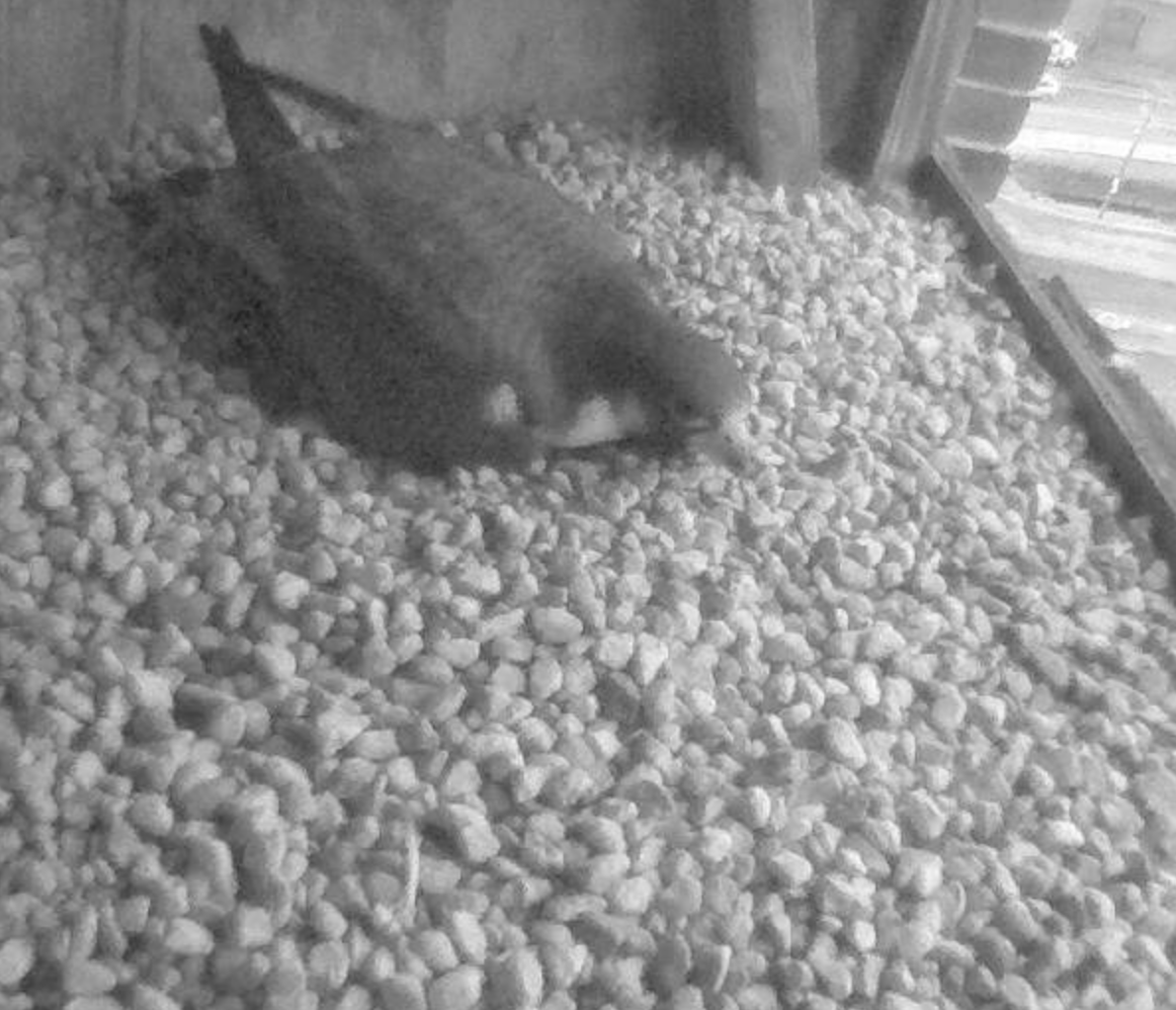
March 24, 2023 under mostly cloudy skies, wind W 8MPH, and temp at 44F. Webcam in the morning, male working on the scrape by laying his chest down and and using his legs to forward to deepen the scrape bowl.
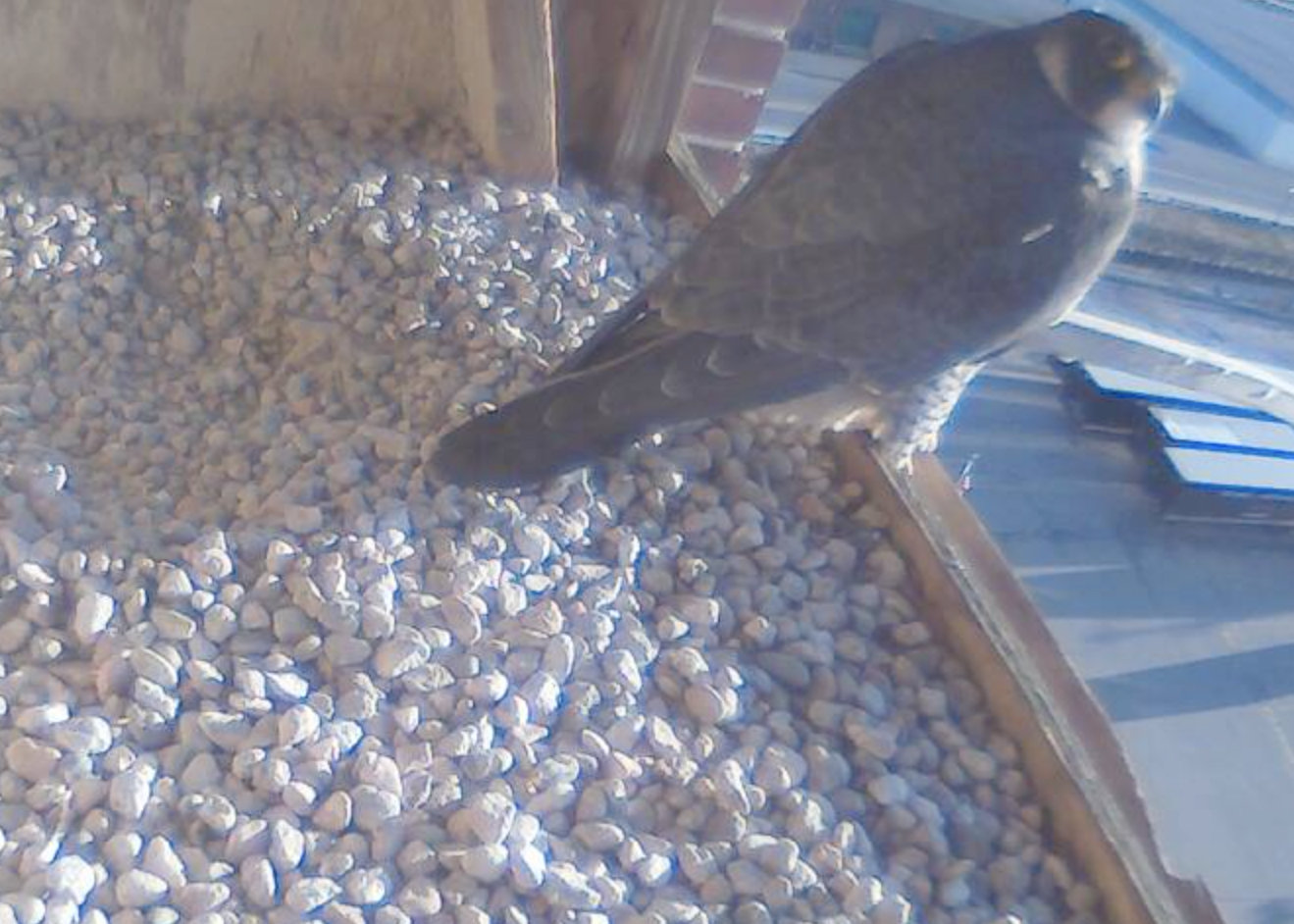
March 26, 2023 at just after 6PM, under clear skies, strong W winds at 16MPH with gusts to 26MPH, and temp at 54F. The female continues to linger and spend time in the New Balance nest box.
Lawrence Peregrines: Verizon Cell Tower

February 8, 2023 in Near the Clock Tower

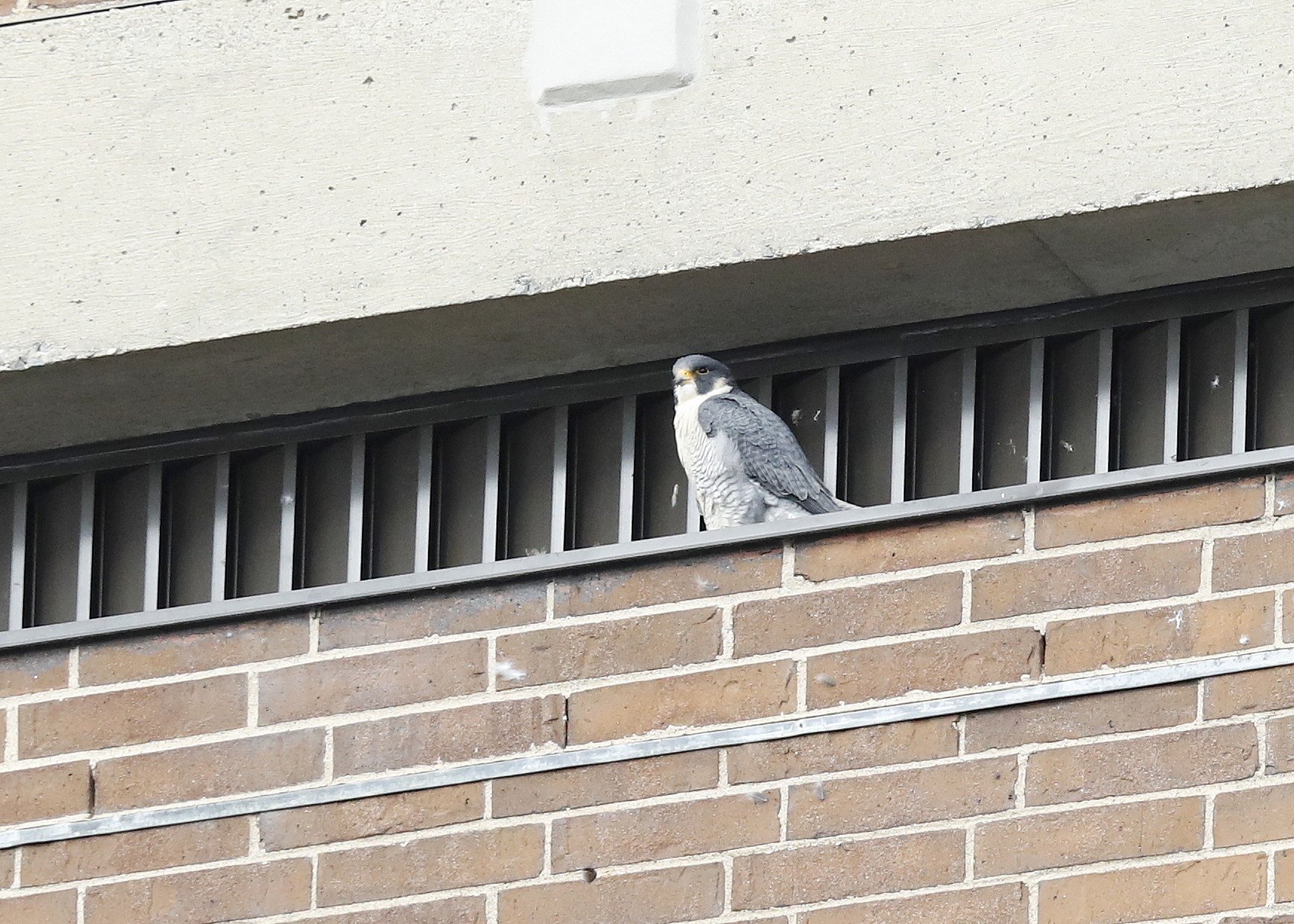
On Feb. 8, 2023, made a search for the Lawrence Peregrines all along Merrimack Street and then on the north side of the Merrimack River in the extended area around the Casey Bridge. Discovered both Peregrines loafing on hot air exhaust ledges located on the south side of the Verizon cell tower. These have been regular winter perching locations and facing south for maximum sunshine exposure!

At this point in the annual breeding cycle, they are renewing the pair bond and spending more time in perch locations together, or nearby one another. Still a bit early to see how this season plays out and where the female will decide to lay eggs, around the end of March or early April.


Lawrence Peregrines: mock combat!

June 26, 2019 in Near the Clock Tower

_W7I6865-001The young Peregrines were out in full force this afternoon in and around the Verizon Cell Tower on Hampshire St.  This has been a regular location for the young Peregrines over the past few years after they have fledged.  One of the two females, the one with leg band, BV/66 was seen on the rooftop on the Verizon Tower while taking a short break.  These young Peregrines spend a lot of time in playful mock combat and then time to res


Observed one of the peregrine fledglings in aerial flight with large loops and infrequent diving stoops. Quite an exciting show from the young fledgling. To my surprise, another fledgling joined the fun and the real show got underway! For over 20 minutes, they proceeded to engage in an amazing demonstration of playful mock combat. Here is
an explanation of mock combat from Cornell’s Birds of North America:

_W7I7049-001Play occurs mainly in young. Immatures will pursue adults, siblings, prey, and attack inanimate objects.  Playful pursuit of siblings begins 2–3 d after first flight, mock combat between siblings begins 4–5 d after. Mock combat progresses from flying parallel and occasionally rolling to extend feet toward siblings, to making short darting dives and grappling in the air, to using air currents to make vertical stoops. Latter develops within 3 wk of flying. Play in falcons may be an expression of joie de vivre or it may simply represent the maturation of neuro-muscular coordination and central control mechanisms involved in agonistic behavior and pursuit and 
capture of prey.

Lawrence Peregrines: loafing around Clock Tower!

June 19, 2019 in Near the Clock Tower

_W7I6483-001Made a late afternoon visit to South Canal St. to observe the fledglings around the Clock Tower under overcast skies, light winds, and temp at 66F.  Had a chance to see all three peregrine chicks and both adult parents.  The cover photo shows two of chicks loafing on a ledge on a NW corner of the Clock Tower.  The adult female is on lookout on the ledge below and the adult male does a flyby to keep an eyes on the young ones. In this photo, the scene shows the young ones loafing, female below, and the male has just landed to the right.


_W7I6433-001One of the great joys of monitoring a peregrine falcon nest, eggs, hatchlings, nestlings, and then fledglings, is the exciting moments around first days of flight.  Although they rest quite a bit, as they adjust to their new life outside the nest box, their flight patterns are a joy to behold.  Most of the flight patterns are a bit awkward, their takeoffs and landings, a bit uneven.  They love to zoom around in playful flight with adults and each other. Flights grow stronger day by day over the first week.  Many times the youngsters will engage in mock combat drills with rolls and outstretched talons. The family usually remains close around the Clock Tower, roosting in many different locations. By now the nest box looks bare, with few remains left behind.

Lawrence Peregrines: on the wing!

June 18, 2019 in Near the Clock Tower

The Peregrines started off this morning under mostly cloudy skies, wind from NE at 5MPH and temp at 62F.  The forecast calls for a chance of showers, mainly after 9am. Cloudy, with a high near 73. Calm wind becoming northeast around 5 mph in the afternoon.  Tonight, isolated showers before 1am. Patchy fog after 5am. Otherwise, cloudy, with a low around 58. Light southeast wind. 

_W7I5920-001What a joy to watch these young Peregrines on the wing and in flight around the Clock Tower.  Made my way over to the Clock Tower last night just after 5:30PM.  While heading over the Duck Bridge, it was possible to see a number of Peregrines in flight while circling the Clock Tower.  From a big picture perspective, the young falcons will be seen in this general area for the next 6-8 weeks.  This has been the pattern every summer over the last number of years.  At times, it is a challenge to find them, but tend to they stay around and remain within a  3/4 mile radius. The cover photo shows 65/BV, the chick that had fledged first thing Monday morning. She is turning in flight around the west side of the Clock Tower!  This photo shows the ever vigilant mother keeping a close eye on her brood.

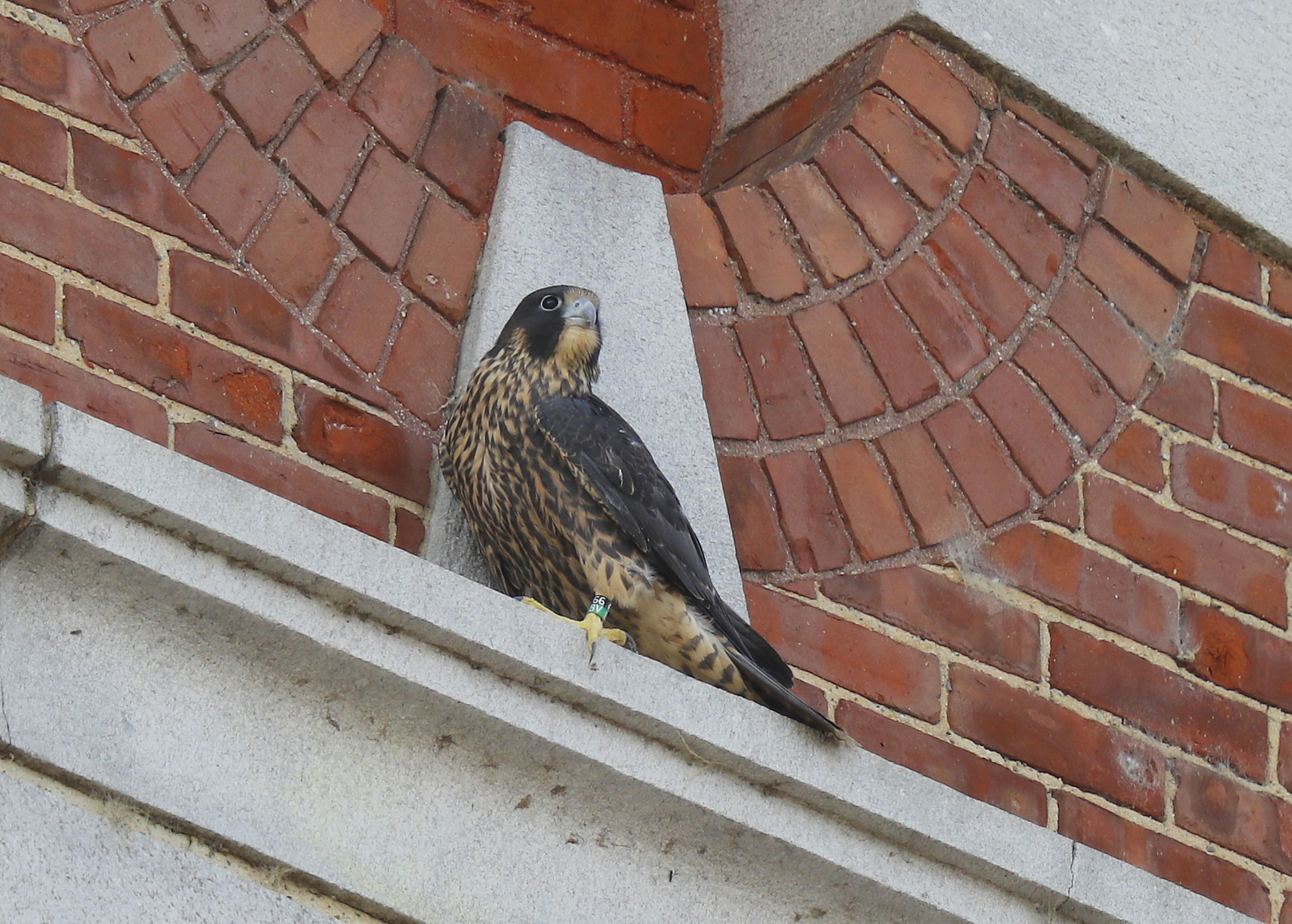
_W7I6305-001After searching a bit longer, was able to also locate and observe the young female, 66/BV.  She was wedged tightly into a granite ledge corner on the SW corner of the Clock Tower, well below the clock face.  The ledge, on the south side, was very narrow and made moving around very difficult.  She walked back and forth along the ledge a number of times with little room for error. She was kind enough to provide a clear view of her leg bands for positive identification!

Lawrence Peregrines: both females fledge!!

June 17, 2019 in Near the Clock Tower

The Peregrines started off this morning under patchy fog before 8am. Otherwise, mostly sunny, with a high near 80. West wind 3 to 5 mph. The forecast calls for mostly cloudy, with a low around 61. Light south wind.  The remaining Peregrines are both females. 

2019.0617.1Female chicks tend to make first flight a number of days later that the young males.  Both females were seen lounging in the nest box as late as 8:45PM on Sunday night.  It looks like the female chick with the 65/BV leg band departed first thing this morning!  The second female had a nice meal dropped off by the adult female around 6:45AM.  She continued to exercise her wing muscles.  She moved all around the nest box, and hopped out onto the perch pole.  At times she moved to the outer length of the pole and just barely in sight of the web cam.  She finally launched into flight late morning!

Lawrence Peregrines: Day 43

June 16, 2019 in Near the Clock Tower

The remaining two Peregrines started off Father’s Day under overcast skies, light rain, and temp at 64F.  The day ahead calls for mostly cloudy skies with a few scattered showers around midday and into the afternoon. Still mild, but a bit cooler than Saturday with highs around 70!

2019.0616.1The two remaining chicks were seen in the nest box all day.  They are so ready to make first flight! One of the chicks hopped out onto the perch pole and was flapping vigorously, but not quite ready to launch into flight. The web cam will continue to operate, but little chance we will see any further action through the cam.  The chicks will be seen over the next many weeks in and around the area near the Clock Tower.  The chicks will be learning to fly while the parents continue to feed them. The young falcon, as it launches into the world, is a most handsome bird, and when the last vestiges of down are shed from the head, it has the regal appearance of the adult. The eyes have by now, taken on that extraordinary quality of lustrous vitality and intense watchfulness that even the best paintings cannot capture in its fullness.

Literature cited:

Ratcliffe, D. 1993. The Peregrine Falcon. 2nd ed. Carlton, England: T. and A. D. Poyser.