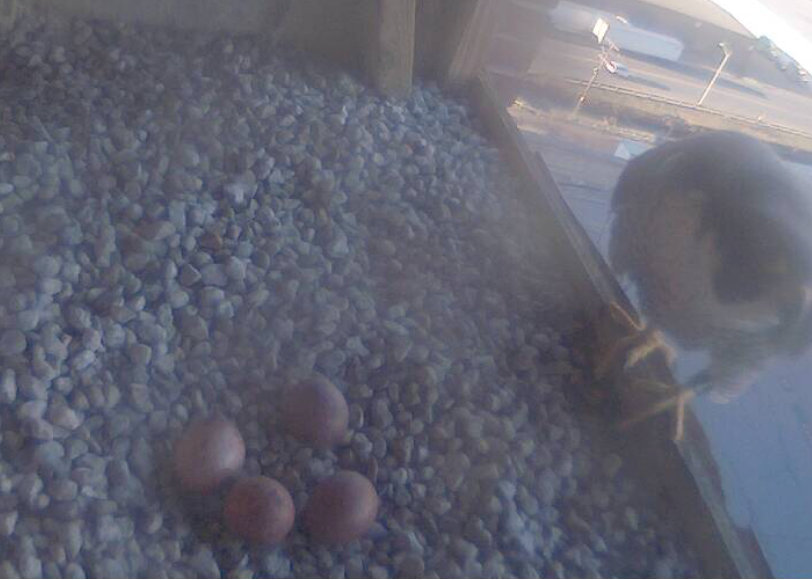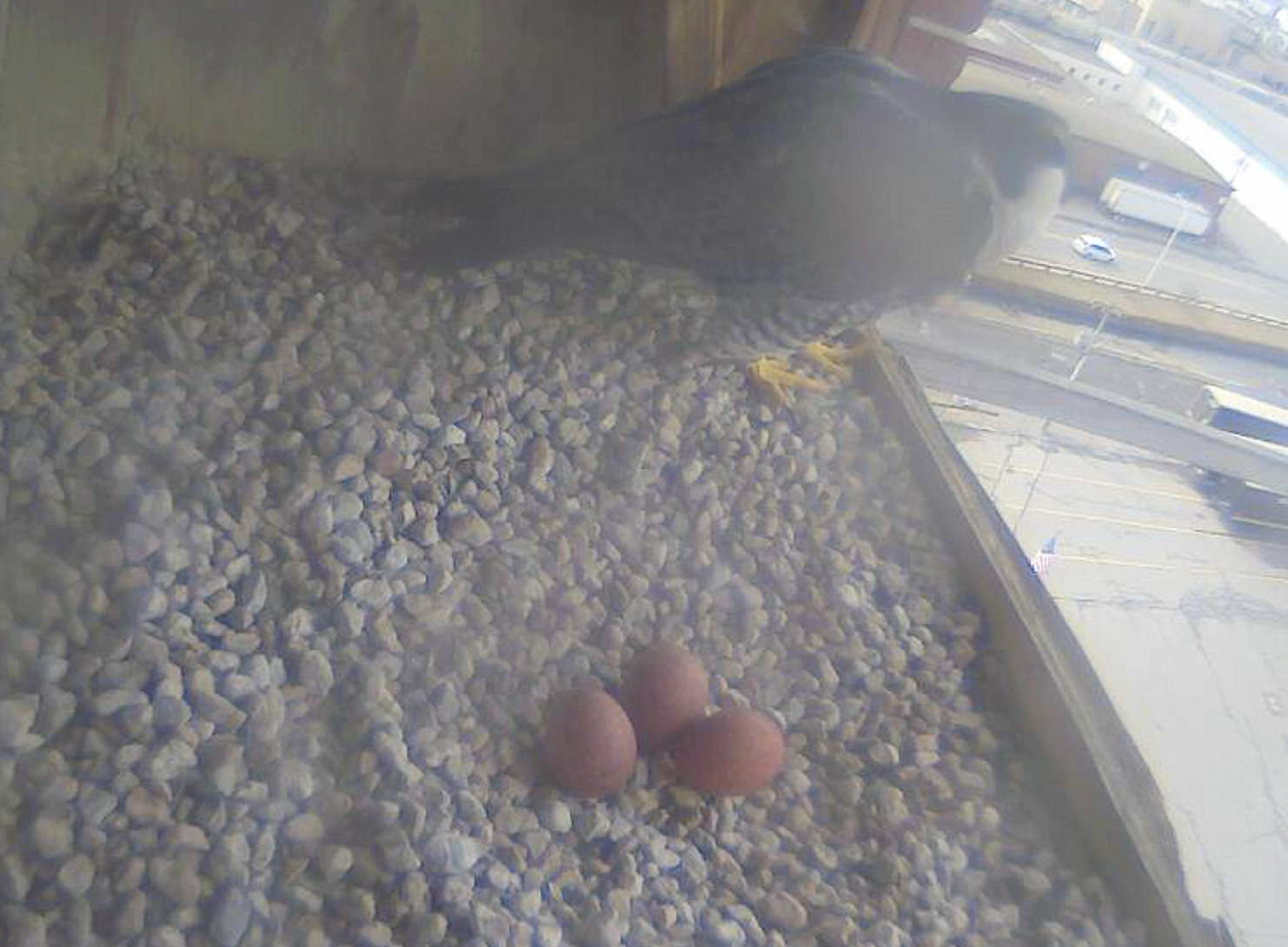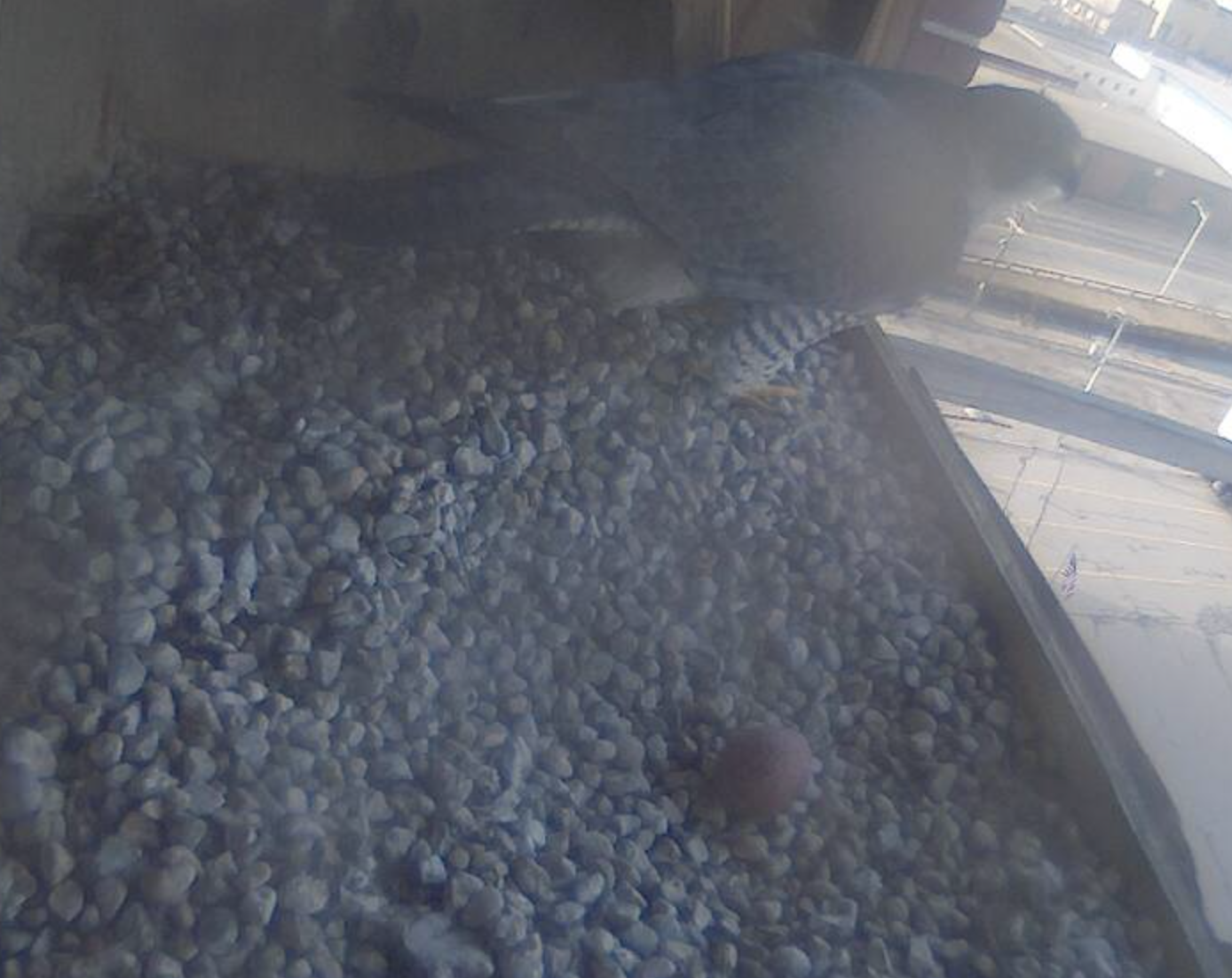
Lawrence Peregrines: chicks in a huddle!

May 13, 2019 in In the Nest Box, lawrence peregrines

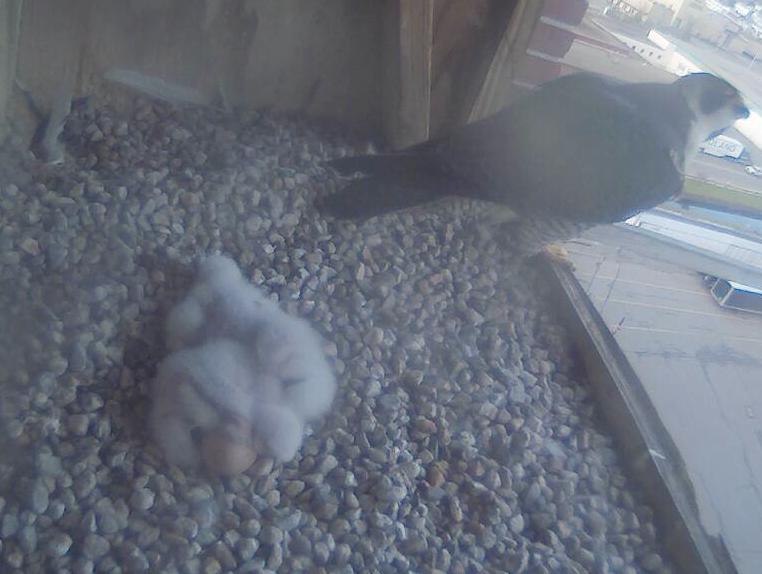
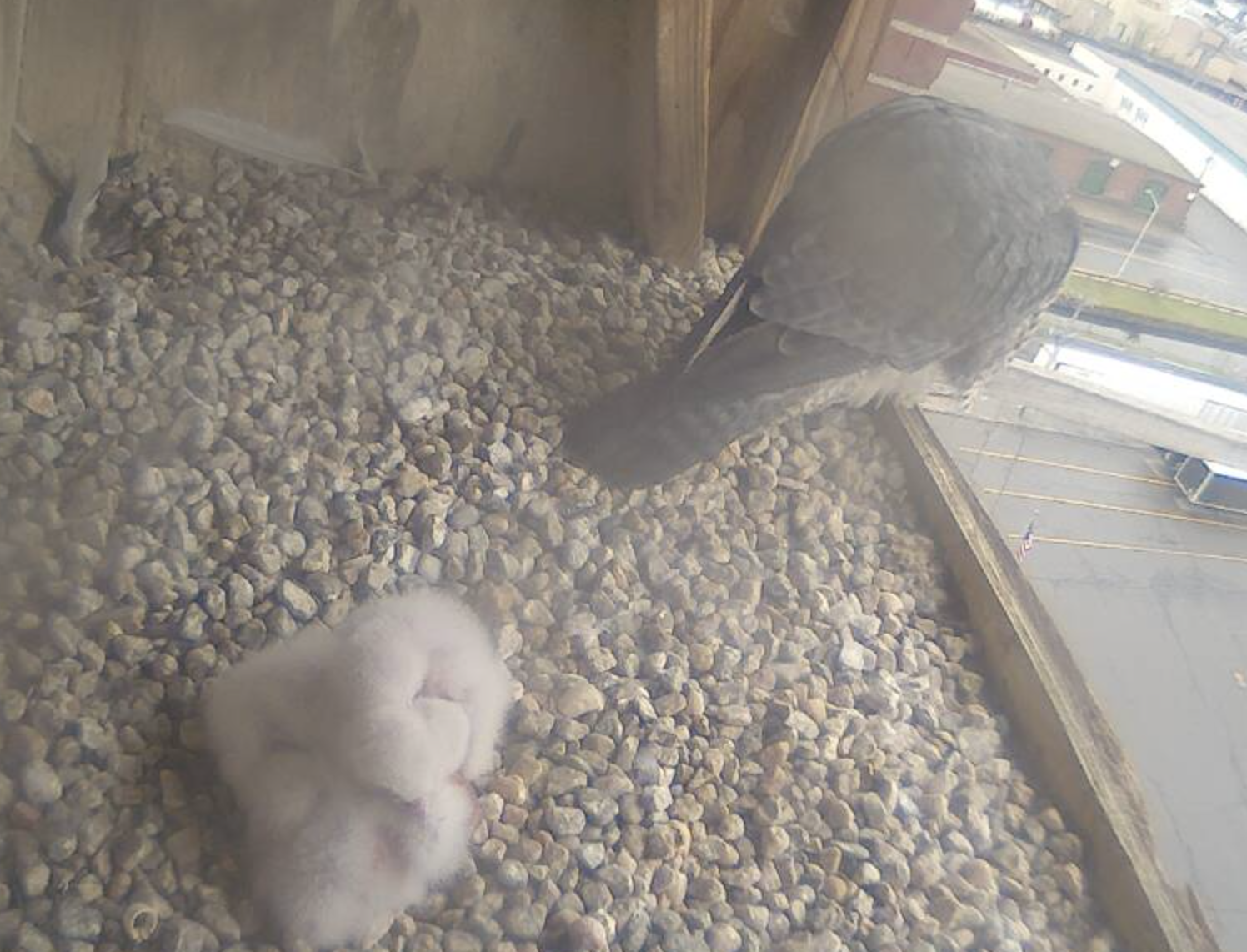
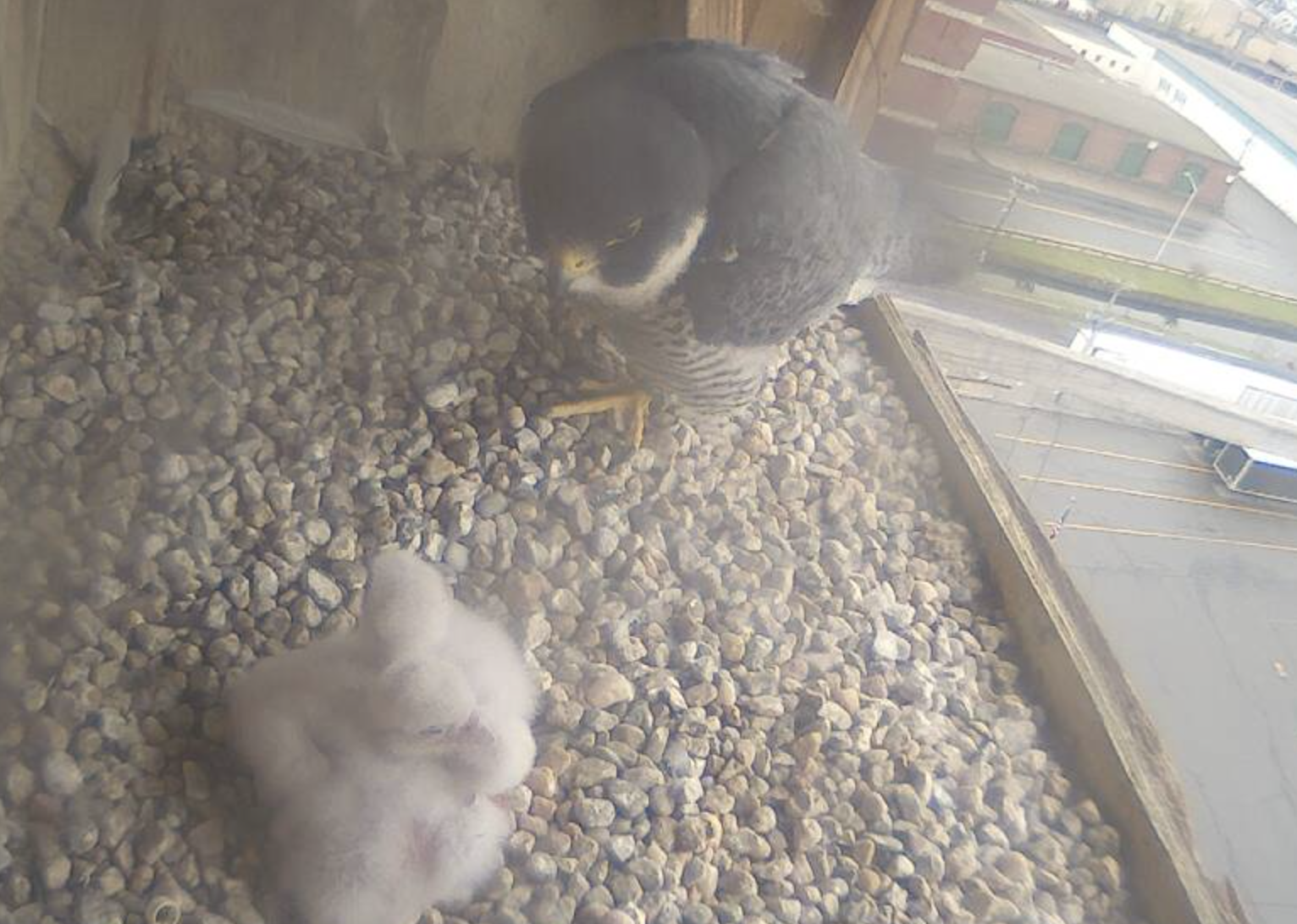
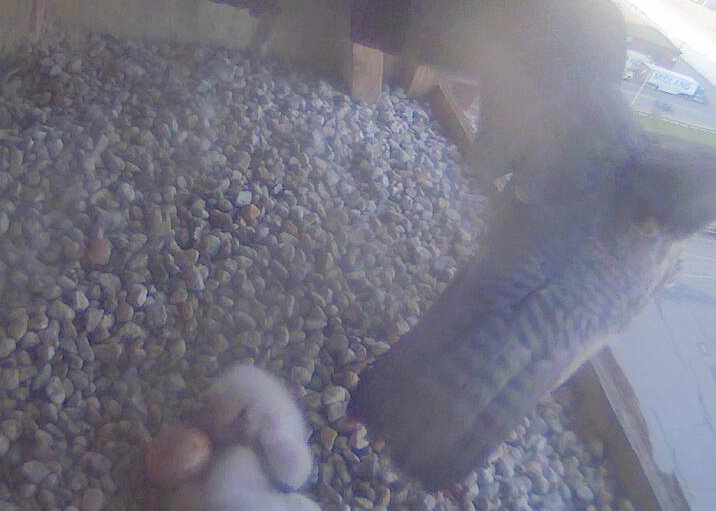
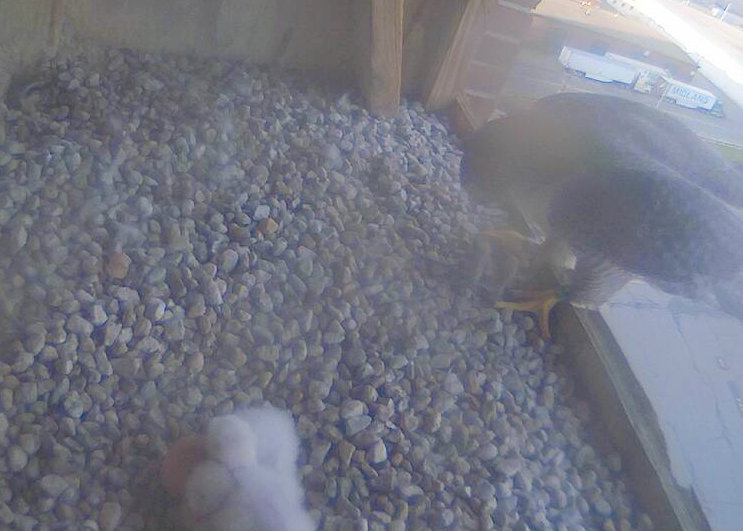
2019.0513.3The forecast for today calls for a chance of rain, mainly after 4pm. Mostly cloudy, with a high near 53. Light northeast wind becoming east 8 to 13 mph in the morning. Winds could gust as high as 24 mph. Chance of precipitation is 30%. For tonight, rain, mainly after 7pm, fog after midnight, low around 39F. Northeast wind around 10 mph, with gusts as high as 23 mph. The nest box faces to the west, so the chicks will be out of the direct wind. The female will start taking more breaks like this, from active brooding.

Now let’s take a look at an overview of growth and development over the total 40 days.  Here’s a bit of what to expect:

At 5 days after hatch, their mass has doubled. The eyas can sit with relative ease, and the open eyes are more round.

At 6–8 days of age the second down (mesoptile or preplumulae) starts to emerge, first on humeral and alar tracts but no down visible on belly at 6 day, although on the legs and belly at 8 days. Also second down is well out on the wings and looks a bit blueish and sheaths of primaries breaking skin on wings.

By 10 days of age the second down is complete and uniform and outer rectrices are breaking skin. At 10 days, primaries growing at 2–3 mm/d, rectrix sheath not yet split.

At 14 days the second down is dense and long, rectrix sheath about 2 mm and typically ninth primary emerges from sheath.

By day 17 the contour feathers start to push out prepennae and only pale (buffy) tips of rectrices have emerged but growing at about 2 mm/d (since day 13).

By 10 days of age the second down is complete and uniform and outer rectrices are breaking skin. At 10 days, primaries growing at 2–3 mm/d, rectrix sheath not yet split.

At 14 days the second down is dense and long, rectrix sheath about 2 mm and typically ninth primary emerges from sheath.

By day 17 the contour feathers start to push out prepennae and only pale (buffy) tips of rectrices have emerged but growing at about 2 mm/d (since day 13).

At 20 days while still with heavy coat of second down, brown contour feathers are visible on margins of wings, tail, and faintly around the eyes.

By 30 days young appears about half down-covered and half feathered; while side of face well feathered, crown still covered with down.

At 35 days while mostly feathered, large conspicuous patches of down around legs, under wings, and on crown.

At 40 days almost fully feathered with traces of down on crown and under wings and outer several remiges; rectrices not fully grown but bird capable of weak flight.

Literature cited:

Veldhuis, Froona, Eyases growth and development                                                                                                                                                          http://falcoperegrinus-froona.blogspot.com/2008/04/eyases-growth-and-development.html

Unhatched “addled” egg remains?

May 12, 2019 in In the Nest Box, lawrence peregrines

Today started off under light winds, overcast skies and temp at 47F. How nice to see the little ones starting to move around a bit more.  They were first seen tightly huddled around each other and the remaining unhatched egg.  It almost looked like they were trying to incubate the egg themselves!

2019.0512.2The female was observed around 9:20 AM this morning taking a break, moving to front edge of nestbox, and calling for food!  The fourth egg has not hatched, and at this point, it is unlikely to hatch.  In prior years, the falcons have had unhatched eggs.  An unhatched egg, may also be referred at as an addled egg.  This is an egg in which the developing embryo has died. Not to be confused with a clear or infertile egg, though in common usage the term is often applied to any egg gone bad.

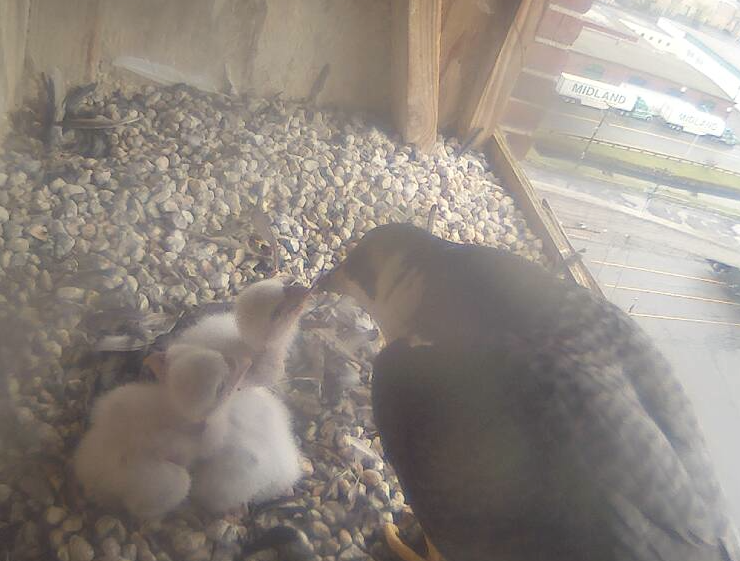
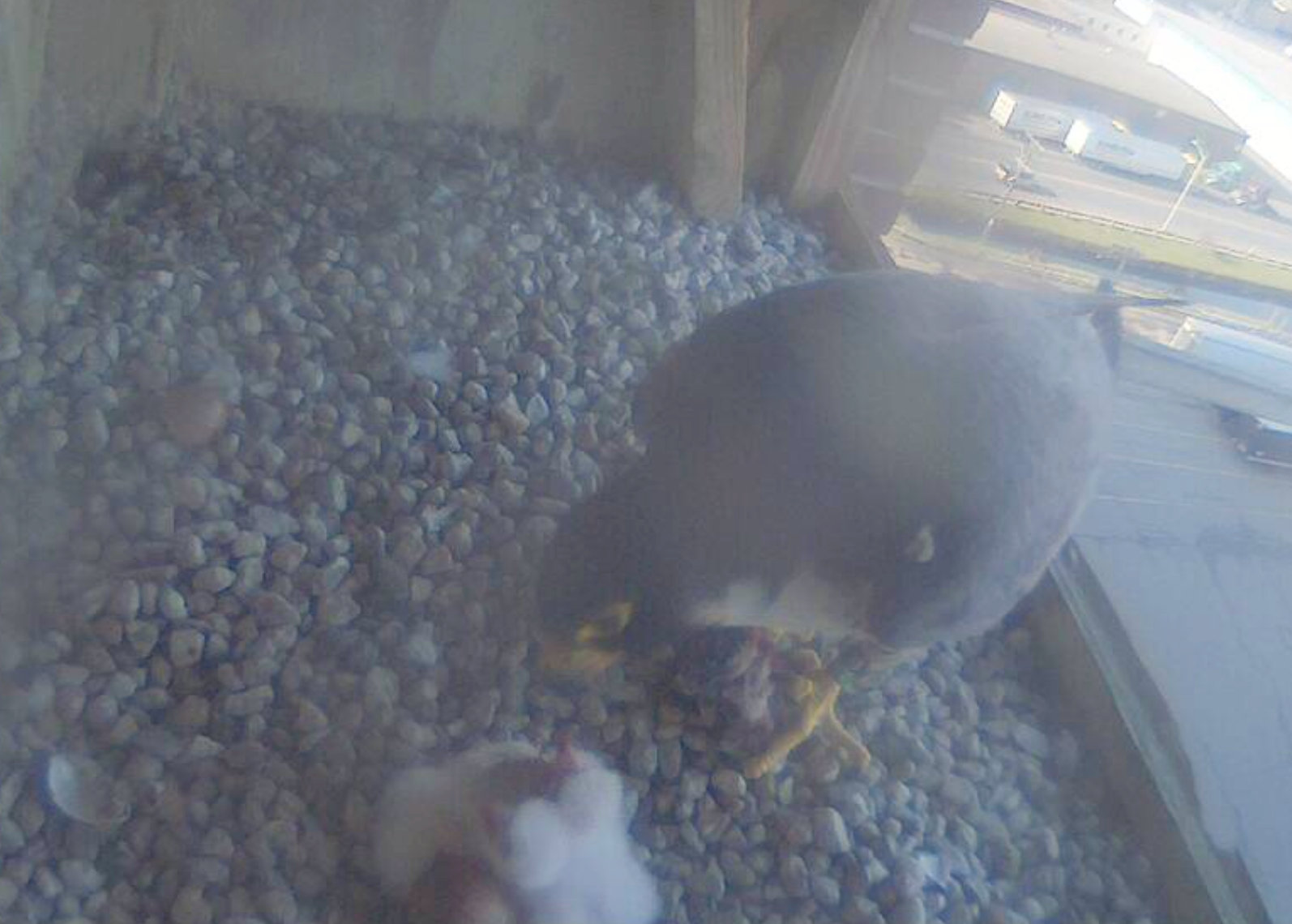
2019.0512.3Around 9:25AM, after a lot of vocalizing, the female was provided with another meal, by the male for the chicks.  The photo shows the female returning to the huddled chicks, with prey in her bill.  The bird in her bill has been stripped of feathers and is ready for her to rip apart for feeding purposes.  Also visible is the remaining unhatched egg. Addled eggs are usually left, and may survive after the young have gone as dried and bleached relics, kicked to the side of the nest box, but they are often broken and trampled to pieces!

Literature cited:

Ratcliffe, D. 1993. The Peregrine Falcon. 2nd ed. Carlton, England: T. and A. D. Poyser.

Lawrence Peregrines: feeding time for 3 chicks!

May 9, 2019 in In the Nest Box, lawrence peregrines, Peregrine Falcons Eastern Massachusetts, Peregrine Falcons Massachusetts

LP.2019.0509.1The morning started off under clear skies, calm wind conditions, and cool at 37F just after 6AM. The female lifted up and off the 3 chicks just before 6:15AM for brief flight and returned with breakfast for the three chicks.  The fourth egg remains unhatched.  This has happened in years gone by.

Peregrine Falcon chicks are helpless. One parent (often the female but sometimes the male) stays with the chicks while the other finds food for the brood. Eyases eat an incredible amount of food – but then, they double their weight in only six days and at three weeks will be ten times birth size.

LP.2019.0509.2Newly hatched chicks are wet and covered with white down. But by three weeks of age, brownish juvenile feathers can be seen poking through the white fuzz. By five or six weeks of age, the white fuzz has been completely replaced by brown feathers. The eyases can be observed jumping around and testing their wings, getting ready to fly.

Lawrence Peregrines: 3 hatchlings!

May 7, 2019 in In the Nest Box, lawrence peregrines

2019.0507.2-001The three chicks started the morning off being closely brooded by the female until she finally rose up and lifted after just after 7:30AM. This image shows the three little newly hatched chicks eagerly stretching their necks forward and gaping their mouths to receive the fresh prey from mother bear.  Her state green/black legs bands can be clearly seen on the left leg. Given the amazing process of carefully incubating these eggs over the last month, we now have front row seats to watch this year’s family start their lives with love, care, and tenderness from very attentive parents!  This truly is the circle of life in the animal kingdom and it is always a precious sight to behold!

Just back from being out of the country, and looking for day/time for hatching of the first three eggs.  Please send an email with info to cbgibson AT comcast.net  …..many thanks!  Craig

Lawrence Peregrines: almost a week!

April 11, 2019 in In the Nest Box, lawrence peregrines

Had a nice opportunity to watch the female in the nest box this morning.  Just before 7AM, she raised herself up a bit and changed positions but remained over the 4 eggs.  Then at 7:07AM, she departed for a few minutes and returned to the box, and then back to incubating the eggs. During incubation, an observer may spend lots of time watching very little activity.  The peregrines take turns brooding the eggs. Typically, the female incubates about 2/3 of the time, often for four or more hours before the male relieves her. Males brood for shorter periods– typically 2 to 3 hours, and they brood less frequently. While one adult is brooding, the other may be out hunting. Brooding falcons still need to eat, after all. If they’re not hunting, the other falcon usually stays close to the nest.  The photo on the left shows the female sitting on eggs quietly and with great comfort.  She will adjust as she needs to but is not fidgety as the male tends to be!

IMG_9570

Sometimes while the female is brooding the eggs, the male will bring her food that he has hunted. She’ll eat the food, sometimes inside, and other times, outside the nest box while he takes a turn incubating, but then she’ll come back and take over– provided she can get him to move off the eggs. If he doesn’t move right away, she may stand in the nest box and wail at him. Wailing has different meanings for falcons, but in general it indicates dissatisfaction with the current situation.  Here they are together, inside the nest box at around 10:35 AM today, and she is wailing on him big time.

IMG_9571So if this female wails at her guy while he’s incubating, or in the nest box it’s her way of telling him she’s not happy that he’s still standing around, or sitting on the eggs. As with most other interactions between male and female peregrines, the female usually gets her way, though sometimes it takes a while for him to get the message!  Guess who’s usually walking away, with his head bowed low, after getting wailed at….the male!

Lawrence Peregrines: Egg #4!

April 5, 2019 in In the Nest Box, lawrence peregrines

2019.0405-001Checked on the nest box just after 6AM this morning under fair skies, wind from west at 9MPH, and temp at 31F. The forecast for today calls for mostly cloudy skies, with a high near 47. Light and variable winds becoming south 5 to 9 mph in the afternoon. For tonight, rain and snow likely before 1am, then rain. Low around 36. South wind 6 to 8 mph. Little or no snow accumulation expected.

After waiting almost an hour for a look this morning, the adults had a shift change at 6:53AM and this provided a quick peek at the 4th egg!  This egg was likely laid at some point overnight.  Had kept a close eye early evening last night and had a clear sighting of just 3 eggs just before sunset, with little egg laying movement seen up until dark settled in.

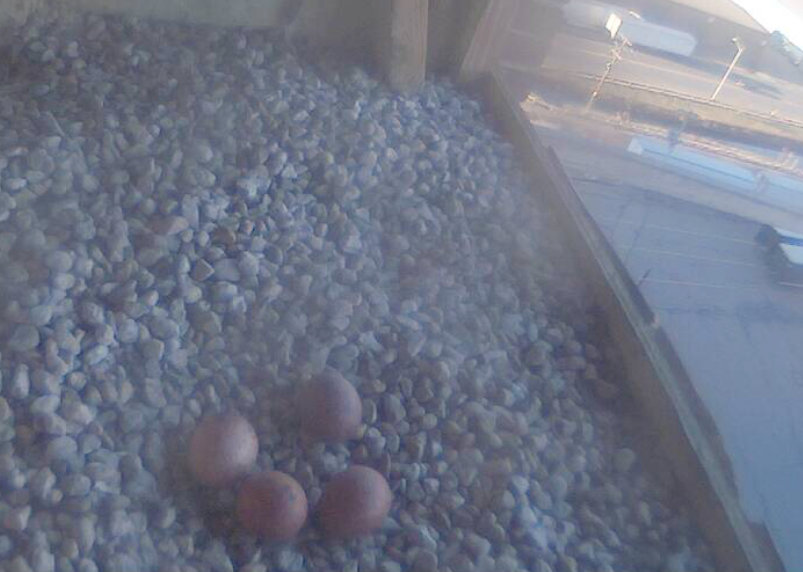
So now, the Peregrines shift into full and shared incubation duties that will last the next 30 days or so!  We are about a week ahead of last year’s egg laying time frame. With God’s grace the circle of life continues!

Lawrence Peregrines: Egg #3!

April 2, 2019 in In the Nest Box, lawrence peregrines

2019.0403.LP-001Always nice to report yet another egg has been laid this afternoon for the 2019 Lawrence Peregrine family!  In most years for this location, the eggs have consistently been laid roughly 48 hours apart.  Last year, the final egg arrived 72 hours after the third egg……no big deal.  We have seen far more incubation going on this year prior to the third egg being laid.  Today we had clear skies, afternoon temps just into the low 50’s, and winds from the SW at 15MPH, with gusts up to 25MPH.  Let’s look for final egg on Thursday afternoon!

Any questions or comments, feel free to check-in at cbgibson AT comcast.net!

Lawrence Peregrines: Egg #2!

March 31, 2019 in In the Nest Box, lawrence peregrines

The morning started off under mostly cloudy skies, wind from the south at 12MPH and gusts up to 23MPH, and temp at a balmy 57F.  The forecast calls for showers, mainly after 1pm. High near 63. South wind 11 to 16 mph, with gusts as high as 31 mph. Chance of precipitation is 80%. New precipitation amounts between a tenth and quarter of an inch possible.

2019.0331The female was observed inside the nest box just after 7AM this morning, both standing over the first egg and then nestled down lower in incubation mode.  She constantly looked around and also vocalized a bit at times. The wind circulated just enough inside the nest box to move her feathers around while she incubated the egg.  In prior years, the first egg would be left for longer periods unattended, but this year seems to be getting more active attention.  As an observer, you may have to keep watching for a while until she lifts up off the egg and takes a break!

2019.0331.1

Checked back in later in the afternoon and the second egg had yet to appear and then checked back just before 6PM and the second egg was seen when she lifted up for a few moments and took off for a bathroom break! We’ll look for the next egg to be laid, hopefully on Tuesday afternoon!

Lawrence Peregrines: first egg!

March 29, 2019 in In the Nest Box, lawrence peregrines, Peregrine Falcons Eastern Massachusetts, Peregrine Falcons Massachusetts

After many visits in and around the Clock Tower and many looks through the web cam, including earlier today, what a nice surprise to check in this afternoon and find the first egg laid for 2019!

2019.0329.LP

Finally after waiting and waiting, the female laid her first egg this today!. Her behavior was very consistent with the general lethargy that a female falcon typically experiences in the few days prior to laying the first egg. In many cases this lethargy may last a week or longer. She lazes around and spends lots of time in the nest box, nest scraping, and other courtship related activities.

Incubation usually will not begin until the second to last egg has been laid. In this cool spring weather, with night time temps in the low 30’s, the female will spend some time incubating the egg, but it may not be a non-stop effort!

The female has a silver federal leg band on her right leg; and a black over green 38/BV band on her left leg.  The male has only a silver right leg band and no band on his left leg.

2019.0329.2


Day 42: 3 nestlings fledged and gone!

June 24, 2018 in In the Nest Box, lawrence peregrines, Peregrine Falcons Eastern Massachusetts, Peregrine Falcons Massachusetts

2018.0623-001The 3 peregrine chicks have all now fledged! Now all we see is an empty nest box.  The youngsters rarely if ever return to the nest box once they have fledged.  From time to time, the female will perch on the nest box perch pole, if it provides her with a good vantage point to watch the fledglings.  The action now is all around the Clock Tower.  The nest box will mostly remain empty until the middle of next March when preparations will hopefully once again get underway for the breeding season!