Lawrence Peregrines: Day 12!

May 25, 2018 in In the Nest Box, lawrence peregrines, Peregrine Falcons Eastern Massachusetts, Peregrine Falcons Massachusetts

For the peregrines, the morning started off under clear skies, winds from the south at 9MPH, and the temp at 57F.  The day ahead calls for sunny skies, with a high near 89. West wind 7 to 16 mph, with gusts as high as 29 mph.  Sunrise this morning was at 5:14 AM.
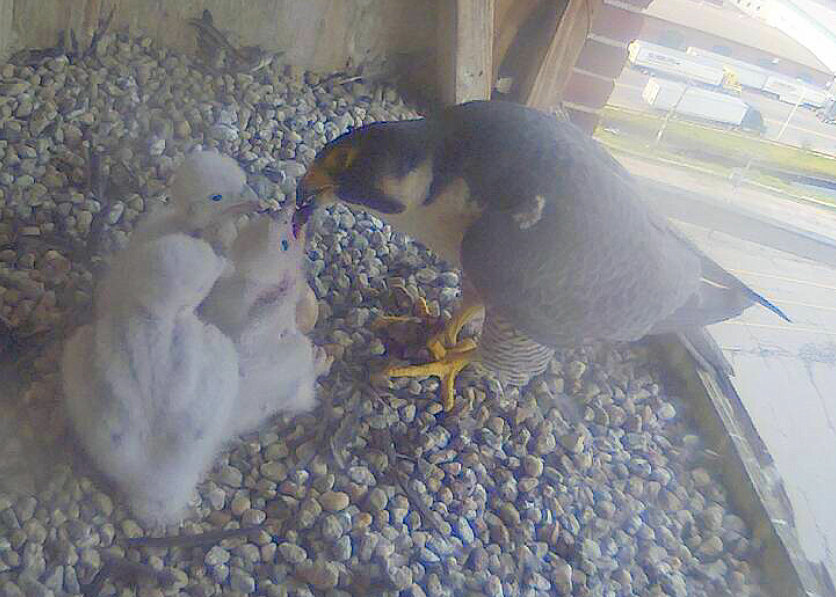
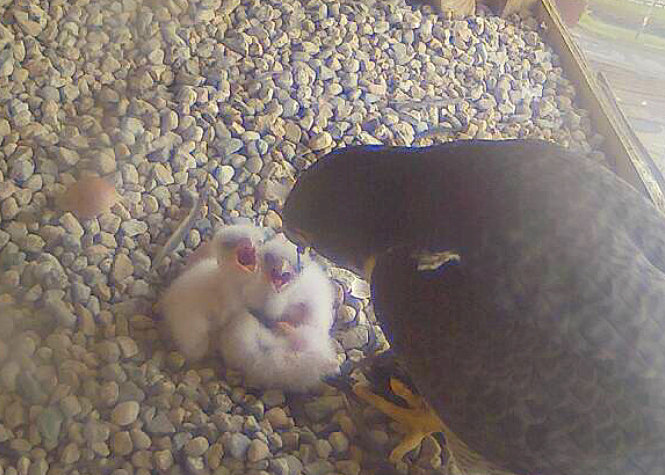
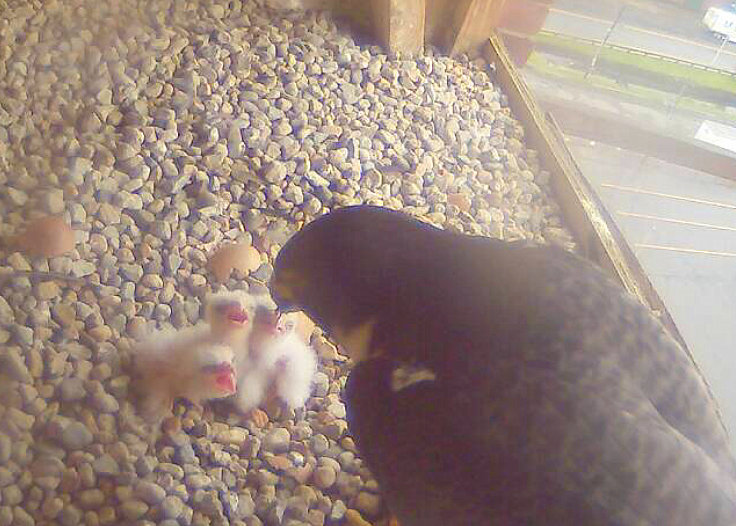
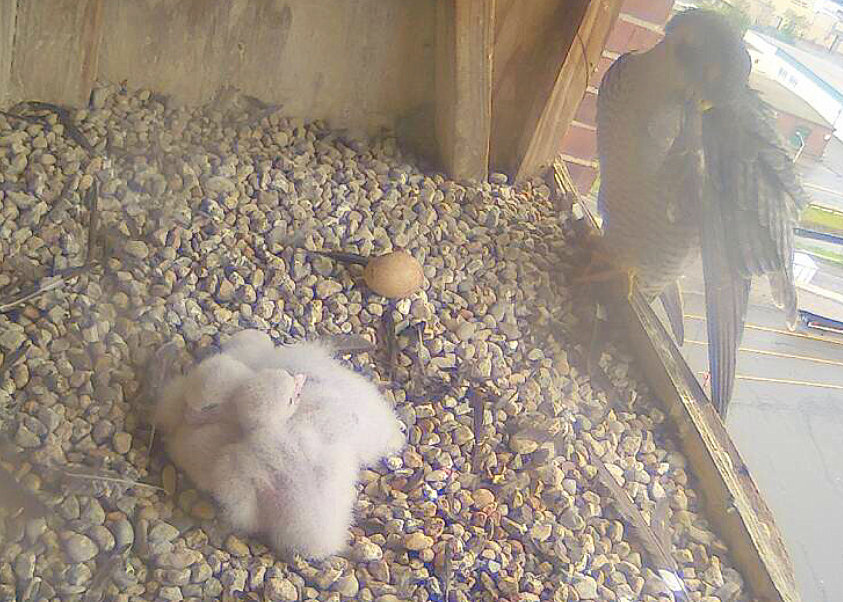
2018.0525.1-001This morning the chicks were first seen int he next box by themselves with the female nearby on the perch pole.  By 5:40 AM she was back in the nest box preening and scratching herself aside the chicks.  Just after that, she settled on the outer edge of the nest box looking out to the west, and the chicks remained in tight huddle formation with the the addled egg still close by.  Right about 7:30 AM, the female returned to the nest box with fresh prey and the chicks had a quick feast. Overall, The little ones are moving around more, wing stretching and being playful with each other.  They are literally a tight bunch at this age!
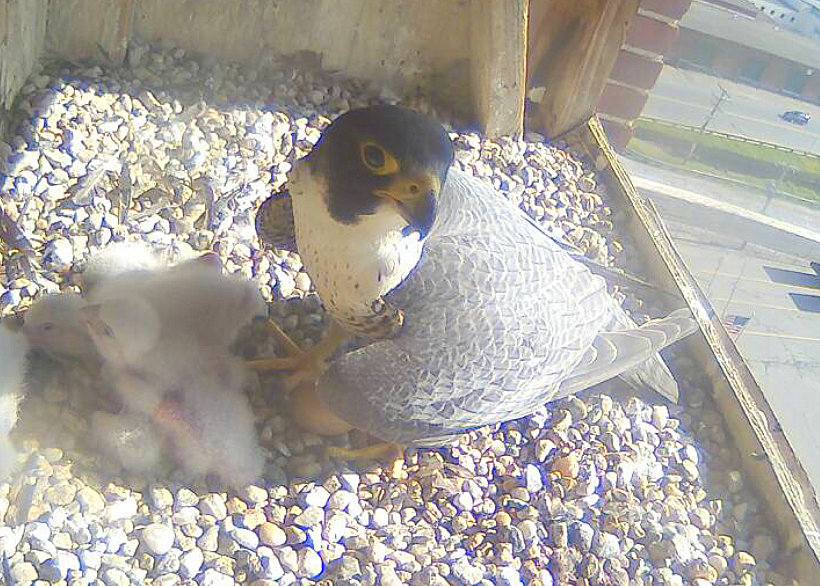


2018.0525.2-001As was mentioned in a prior post, the adults will shelter the nestlings from strong sunshine, and rain, as may be needed, when they are too large to brood but not yet protected by their own feathers.  The sheltering falcon half-spreads its wings, as seen in this photo.  As the overall weather warms up, and these chicks are subjected to hot, intense sunshine afternoons, this type of sheltering may be important and helpful.  The female was seen with her mouth wide open, and tongue hanging out, a clear sign of being somewhat overheated.


Literature cited:

Ratcliffe, D. 1993. The Peregrine Falcon. 2nd ed. Carlton, England: T. and A. D. Poyser.
Lawrence Peregrines: Day 11

May 24, 2018 in In the Nest Box, lawrence peregrines, Peregrine Falcons Eastern Massachusetts, Peregrine Falcons Massachusetts

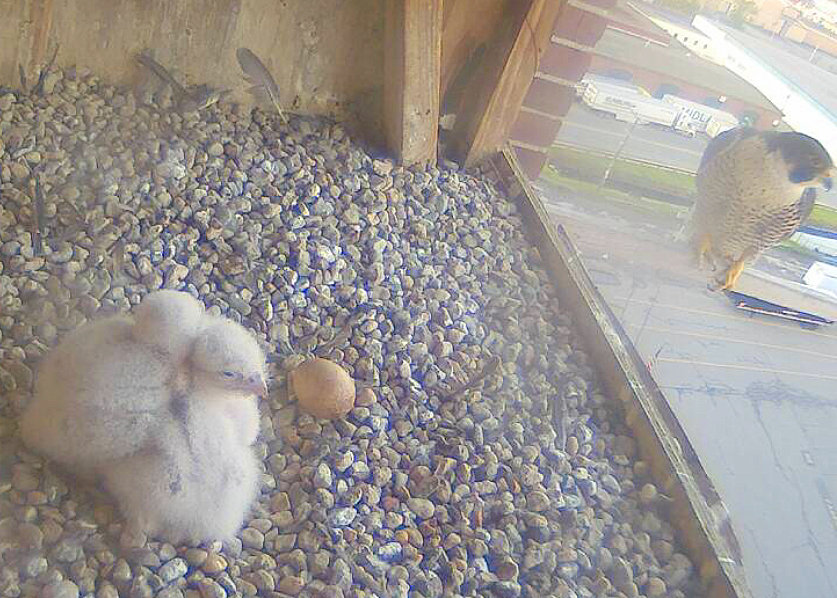
2018.0524.1-001The peregrines started the day off under clear skies and bright sun, calm winds, and the temp at 53F.  The day ahead calls for mostly sunny skies, with a high near 69. Light north wind increasing to 5 to 9 mph in the morning. Just before 5:30 AM, the female was seen hovering near the chicks but not really brooding them.  The little ones continue to stay close ton one another in a constant huddle formation.  By 5:30, the female moved out to the perch pole, keeping an eye on her chicks but remaining very close.  Finally, around 6:30 AM, she returned to the nest box with prey in talons and feed the hungry little ones!


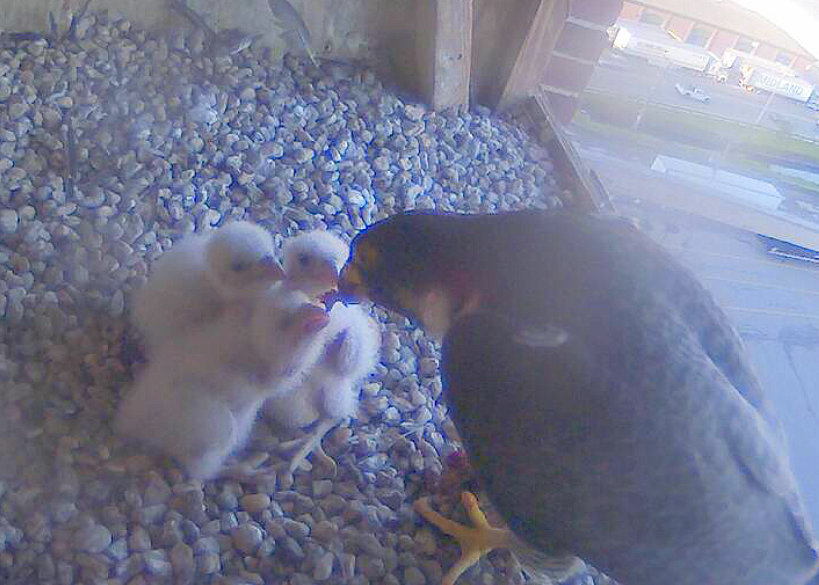
2018.0524.2-001By day 11, the beak is already beginning to acquire a slightly yellow tinge, as opposed to the pink color it has had to this point in the chick’s development.  In regard to feeding behavior, hungry chicks solicit even if the adult arrives without food, but when satiated they remain indifferent. R. W. Nelson observed that chicks tend to form a semi-circle in front of the parent or to one side and all received portions of the prey item. Another researcher found that each chick was fed in turn until satiated, when it dropped back and was replaced by the next in line. After 10-12 days, chicks which called most received the most food


Literature cited:

Ratcliffe, D. 1993. The Peregrine Falcon. 2nd ed. Carlton, England: T. and A. D. Poyser.
The Canadian Peregrine Foundation, Peregrine Falcon Development – Age Guide; http://www.peregrine-foundation.ca/info/ageguide.html

Lawrence Peregrines: Day 10

May 23, 2018 in In the Nest Box, lawrence peregrines, Peregrine Falcons Eastern Massachusetts, Peregrine Falcons Massachusetts

The morning started off under mostly cloudy skies, winds from the SW at 6MPH and temp at 57F.  The day ahead calls for partly sunny skies, then gradually becoming sunny, with a high near 83. Southwest wind 5 to 9 mph becoming northwest in the morning.  The sunshine will arrive later today and stay with us into the weekend.

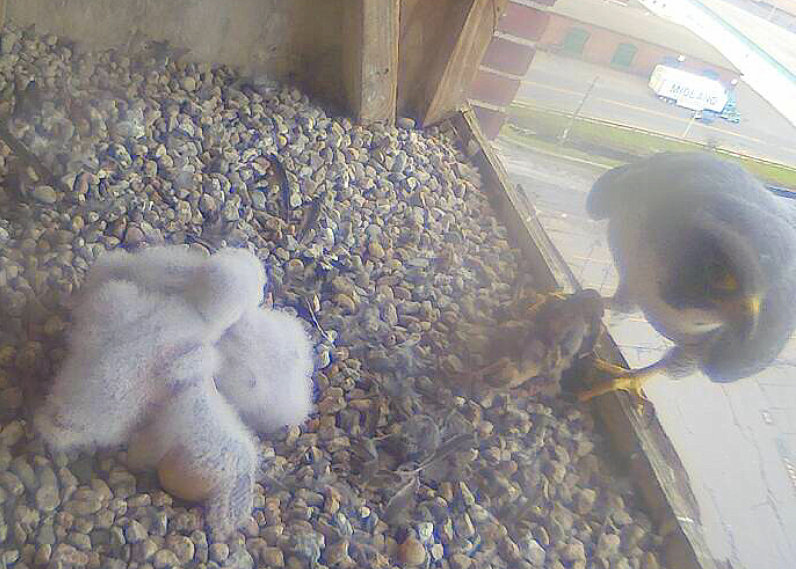
2018.0523.2-001Just before 6 AM, the female was seen in the nest box preening, wind stretching, and watching over the little ones.  She departed and returned moments later, again with food in her talons. The hungry chicks were happy to receive a morning meal.  The egg has been moved back into the huddle!  After the feeding session, the female moved to the perch outside the box for a while, and then hopped back inside the nest box.  She settled back in for a bit, spent more time on perch and then returned to hover over her brood!

2018.0523.1-001By day 10, the chicks have already grown visibly, but remain covered in white down with pink patches of skin still showing through in some areas. Around this time, the young peregrines grow a second coat of down. From this age onwards, nestlings become more active and strong though the nature of their movements does not change markedly for another week or so. They are brooded less and less during the day and become more vigorous in their movements about the nest box, including backing up to squirt their feces outside the nest box. Vision develops strongly and the young, when hungry, scream and clamber towards an arrived parent. Most of the day is spent sleeping, up to about 16 days, but the comfort movements, become more developed, and include foot nibbling and hitching of the wings into adult position.

Literature cited:

Ratcliffe, D. 1993. The Peregrine Falcon. 2nd ed. Carlton, England: T. and A. D. Poyser.
The Canadian Peregrine Foundation, Peregrine Falcon Development – Age Guide; http://www.peregrine-foundation.ca/info/ageguide.html

Lawrence Peregrines: Day 9

May 22, 2018 in In the Nest Box, lawrence peregrines, Peregrine Falcons Eastern Massachusetts, Peregrine Falcons Massachusetts

Fair skies, calm wind, 54F with sunrise time at 5:16 AM. The forecast for today calls for showers likely, mainly after 5pm. Increasing clouds, with a high near 72. Calm wind becoming south around 6 mph in the afternoon. Chance of precipitation is 60%. New precipitation amounts of less than a tenth of an inch possible.

2018.0522.1The female started the day off hovering and brooding over the chicks, including the remaining addled egg.  Towards 7 AM, she walked over to the far edge of the nest box and spent time gazing out to the west.  She will begin to do this more and more, getting the chicks use to her taking breaks, and then later breaks away from the nest box, but always nearby.  In the early afternoon, had a nice look and noticed the addled egg has been moved a bit away from the huddled chicks.  It may remain there for now, and be pushed off a bit further in next few days.  The female resumed her position at the far edge of the nest box and spent time preening herself, before feeding the chicks.


2018.0522.2In the early days, brooding and feeding are by the female alone, but the male later takes a share, though a lesser one, in feeding. Both parents are inclined to encourage the chicks to eat more than they appear to want: at 8-9 days, repeated gaping disappears, for the nestling watches the feeding actions of its parent and reaches up to take the food as it is presented. Treble whining increases in volume and is uttered between mouthfuls, but ceases when satiation is reached.


Literature cited:

Ratcliffe, D. 1993. The Peregrine Falcon. 2nd ed. Carlton, England: T. and A. D. Poyser.
The Canadian Peregrine Foundation, Peregrine Falcon Development – Age Guide; http://www.peregrine-foundation.ca/info/ageguide.html

Lawrence Peregrines: feeding time!

May 16, 2018 in In the Nest Box, lawrence peregrines, Peregrine Falcons Eastern Massachusetts, Peregrine Falcons Massachusetts

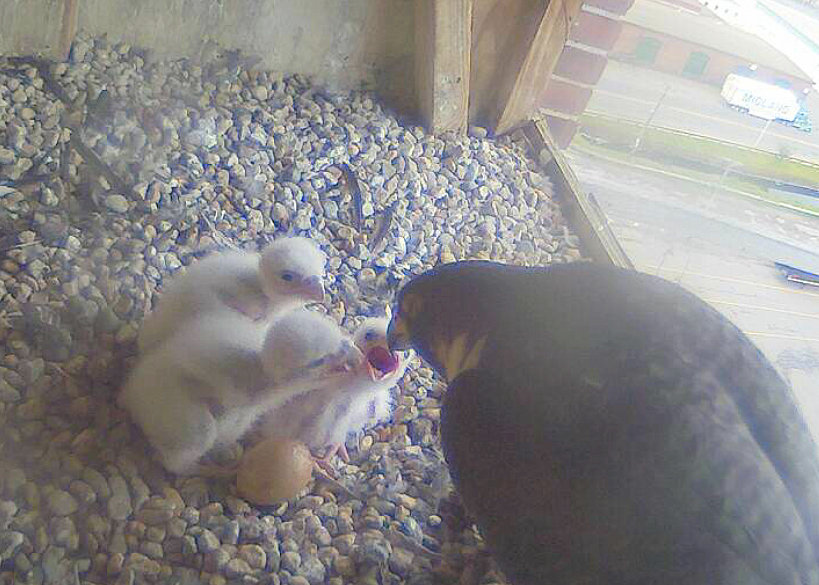
The three chicks started off the morning under fair skies, calm winds, and temp at 56F.  The forecast for the day ahead calls for partly sunny, with a high near 61. East wind 3 to 8 mph.  Had nice looks at morning feeding session just after 5:30 AM, and the three chicks were very hungry and eager to gobble up the offered prey from the female.  The fourth and final egg remains unhatched.  Hopefully it will hatch some later today!

2018.0516-001Most brooding of the small young is performed by the female, though the male occasionally takes short turns.  No attempt is made to share brooding simultaneously.  Apart from weaker motivation for brooding, a male still has greater difficulty in covering a full brood of chicks than a clutch of eggs. Although the actions of the brooding falcon are essentially similar to those of an incubating bird, there are slight and gradual adjustments appropriate to the change of covering delicate but growing nestlings.  Leaning forward and stepping around gradually cease, but shuffling movements become important, evidently to place the feet below the chicks.  Rocking stops on hatching, and other settling motions are replaced by gentle lowering of the body onto the nestlings.

Literature cited:

Ratcliffe, D. 1993. The Peregrine Falcon. 2nd ed. Carlton, England: T. and A. D. Poyser.
Lawrence Peregrines: #3 Hatch!!

May 15, 2018 in In the Nest Box, lawrence peregrines

2018.0515.2-001Had a nice chance to watch the peregrine chicks at noon today.  Hoping to get a glimpse under the incubating female for an update on number of hatchlings.  At this point almost 48 hours has passed since the second egg hatched, and the clock is ticking!  Finally, at 12:05 PM, the male entered the nest box bearing lunch and the two engaged in a classic food exchange.  In the process the female rose up and off the eggs, providing a clear view of the two hatchlings and the two remaining eggs.  It also meant we might be closer to the third egg hatching later in the day.  If we look back, the third egg was laid almost 72 hours after egg number two, so we are right in the zone for the next hatch to take place.


2018.0515.3-001Was only able to get a brief look a few times during the afternoon, and each time, no movement off the eggs.  Checked at 5:22 PM while driving home, and to my great delight, the female had departed and the nest was wide open.  A quick survey showed a clump of white in the middle, two broken shell halves nearby, and what looked to be a final intact shell in the foreground…the third chick had hatched and joined the brood.


2018.0515.4-001A few moments later, the female arrived into the nest box bearing prey and she started to feed the three chicks!  What a beautiful sight!  The tenderness and care that the female shows while feeding these little ones is so very special.  She is turning her head and craning her neck so that the little chicks will receive the food that they need and that will help them grow!


2018.0515.5-001The last image, and perhaps, favorite of the day, shows the three little newly hatched chicks eagerly stretching their necks forward and gaping tier mouths to receive the fresh pray from mother bear.  Given the amazing process of carefully incubating these eggs over the last month, we now have front row seats to watch this year’s family start their lives with love, care, and tenderness from very attentive parents!  This truly is the circle of life in the animal kingdom and it is always a precious sight to behold!


Literature cited:

Ratcliffe, D. 1993. The Peregrine Falcon. 2nd ed. Carlton, England: T. and A. D. Poyser.